Dear Futurists
Plans for a London Futurists gathering in Fleet Street’s Ye Olde Cock Tavern on 22nd October have progressed, with news about a number of short provocations to ignite parts of our conversation at that event.
For more details, and for information about other developments in the world of foresight, read on.
1.) Foresight provocateurs announced for 22nd October
Many thanks to Nick Walker and Isabel Serval for stepping forward to prepare some ideas to present on 22nd October, that will frame sections of our meeting that evening.
As a reminder, we’ll be in our usual Fleet Street venue, Ye Olde Cock Tavern, in the large room up the front stairs.
As an experiment, on this occasion I’ve provided registration options on both Meetup (here) and Luma (here). You can select whichever one you prefer.
In both cases, you’ll see a request to place any food orders in advance, via a Google Form provided there. The venue ask that these orders be placed by 15th October. Food orders made on the evening may be subject to delays, the venue says.
Here’s what Nick and Isabel expect to cover in their sections:
Nick Walker, who is a medical doctor with a PhD in AI, and who serves as Chief Science Officer of the AI-driven invention company Iprova:
- Nick will share a short viewpoint on why AI won’t kill us all, why AI won’t steal our jobs and why current AI is not conscious and why that is a good thing. He’ll also provide an assessment of what has been called “the new Luddites”.
Isabel Serval, Founder at Traversing Futures, and lead at Signal Club – a long-term governance and futures thinking community:
- Isabel will raise the question: Nobody’s having kids. So what? She points out that the emerging awareness of birth rate decline and subsequent long-term population decline tends to be followed by panic, and treated like a bad thing by default. But only a few years ago the world was panicking about overpopulation. She plans to challenge assumptions and judgements when looking at a fictional scenario for the demographic future of London.
Look out for one more provocateur to-be-announced.
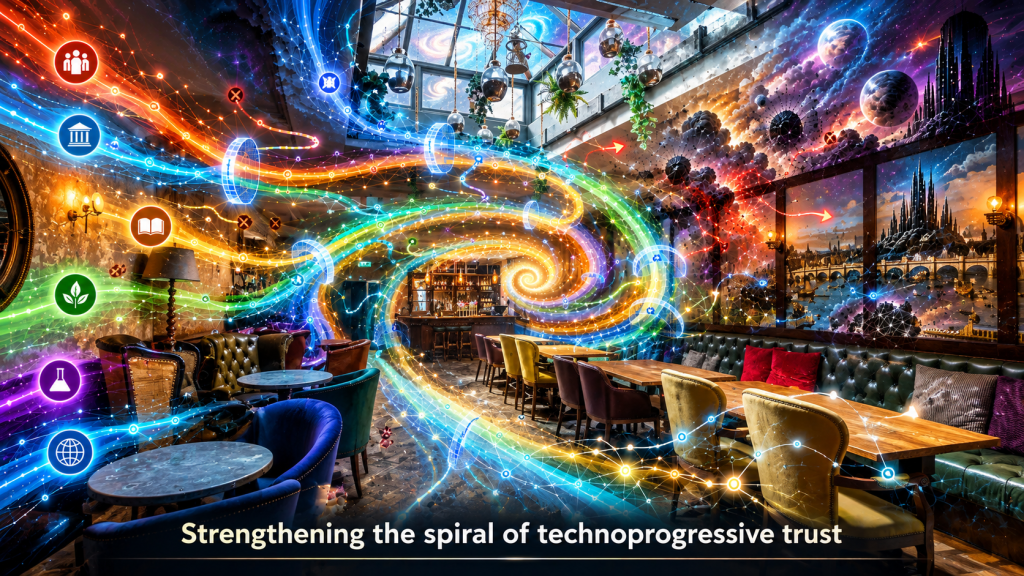
The image above, as you may guess, is an impression of the spiral of multi-dimensional conversation that I expect will take place in the room, as formal and informal conversation progresses.
2.) The Vital Foundation – 25 revisions and counting
The idea of an expanding spiral of technoprogressive trust also underpins my essay The Vital Foundation.
In that essay I argue as follows:
We may want to harness the best of technology while constraining its dangerous excesses. We may want the fruits of abundance to be widely shared, rather than leaving large sections of humanity behind and bitterly alienated. But these ambitions will fragment and fail unless they are built on strong foundations...
But what kind of foundation?
Not an immutable foundation, laid down once and for all. The foundation itself must be open to inspection, repair, extension, and, where necessary, reconstruction. What matters is that some sufficiently robust shared commitments exist to support everything built around them. That’s what’s vitally needed.
These commitments should not require agreement on religion, metaphysics, political ideology, or any single conception of the good life. The challenge is to identify an overlapping foundation that people with very different worldviews can endorse for different reasons – and from which warranted trust can gradually be earned rather than simply assumed.
Below, I set out the case for a technoprogressive foundation – a set of ethical commitments which, following increasingly wide review, evolution, and adoption, could bolster humanity’s collective resilience and wisdom, enabling what I have called a sustainable superabundance for all.

Since I first published the essay in its current location, on 17th September, I’ve received numerous comments and suggestions, that have in turn led me to keep making what I consider to be improvements in the content. It’s now on its 25th update, and I expect I’ll be changing it some more in the weeks ahead.
If you’ve not already read the essay – or if you only skimmed it before – now may be a good time to take a closer look.
The end of the essay now contains listing seven potential next steps. Let me know if any of these particularly interest you.
3.) Recordings from The Technoprogressive Opportunity
Many of you have been in touch with me asking when recordings will be available of the talks and conversations at The Technoprogressive Opportunity held on 19-20 September.
My answer is: real soon now…
The videographers who recorded the event have been addressing a few issues with audio quality. But I expect at least some of the videos to be uploaded over the next week to the London Futurists YouTube channel.
If you’re not already subscribed to it, now would be a good time.
4.) Anticipating the state of longevity, 2031
If you are subscribed to the London Futurist YouTube channel, one thing you’ll find there is this re-recording of a talk I gave on 30th September at the International Longevity Summit in Madrid, Anticipating the state of the longevity community and longevity science in 2031.
It’s a talk that has provoked mixed reactions.
For example, longevity futurist Ira Pastor provided this feedback:
I applaud you on such a comprehensive overview of the situation – It’s a very impressive presentation.
But AI safety activist Rufo Guerreschi was less enthusiastic:
Dear David,
There is not going to be any freaking longevity. Can’t you figure that out yet? You’ve been splitting yourself between longevity, craving, and saving us from extinction [from AI], and as you well have noticed, you have split your time wrongly. You should have had your very talented intellectual brain try to prevent extinction, which was extremely likely, so your longevity aspirations are nowhere to be found.
Please, it’s not too late to come back and fight 100% and not 50% of your brain for a proper and bold treaty.
One other contact of mine told me my talk was geopolitically naive.
What’s your view?
5.) Perspectives on Machine Consciousness
One other topic which is sometimes said to be a distraction from the question of avoiding AI-induced catastrophe is the question of whether AI will ever become conscious.
That issue arose during the most recent episode of London Futurists Podcast, Perspectives on Machine Consciousness.
This episode featured a conversation with me asking questions to show co-host Calum Chace, who is one of the editors of a recently produced book with the same name – Perspectives on Machine Consciousness. That book contains 26 chapters written by a total of 31 authors, who include a wide range of distinguished neuroscientists, philosophers, technologists, AI specialists, science fiction authors, and futurists. The authors are far from being in solid agreement with each other – except for the point that it is both timely and important to improve our understanding of the possibility of machine consciousness.
That leaves the question: if we have a choice for the first AI superintelligence to be conscious or a zombie, which should we prefer?
My own views on this subject can be found in a Mindplex essay Conscious AI: Conflations and Comparisons. I argue that the idea that there is single indivisible phenomenon called consciousness is as misleading as the idea that consciousness and intelligence always accompany each other.
That essay of mine ended by proposing a programme containing six parallel activities. In simple terms, each activity involves deepening public understanding and awareness:
- Of catastrophic risks with the present trajectory
- Of profound benefits from applying wisdom rather than haste
- Of bottlenecks via which control can be established
- Of mechanisms for verification which will build and maintain trust
- Of the utility of incremental progress rather than a single “giant leap”
- Of the power of collective action that opposes the present trajectory
That essay dates from December last year. Reviewing it again just now I am relieved to observe broad alignment with the recommendations in my more recent work on The Vital Foundation.
6.) Cybercapitalism on Steroids Vs Socialist Utop-AI
One person who attended the event The Technoprogressive Opportunity was the filmmaker Ian Diez Young of Reset Media. Ian recorded a number of interviews with speakers and other attendees, and plans to include footage in a series of videos he is producing.
Here’s the first from the series, called Cybercapitalism on Steroids Vs Socialist Utop-AI:
If you have any reaction to that video, please leave a comment on YouTube.
7.) Real-Time Delphi: AGI and Social Coherence 2035
How can we increase the likelihood that AGI will enhance, rather than inhibit, social coherence by 2035?
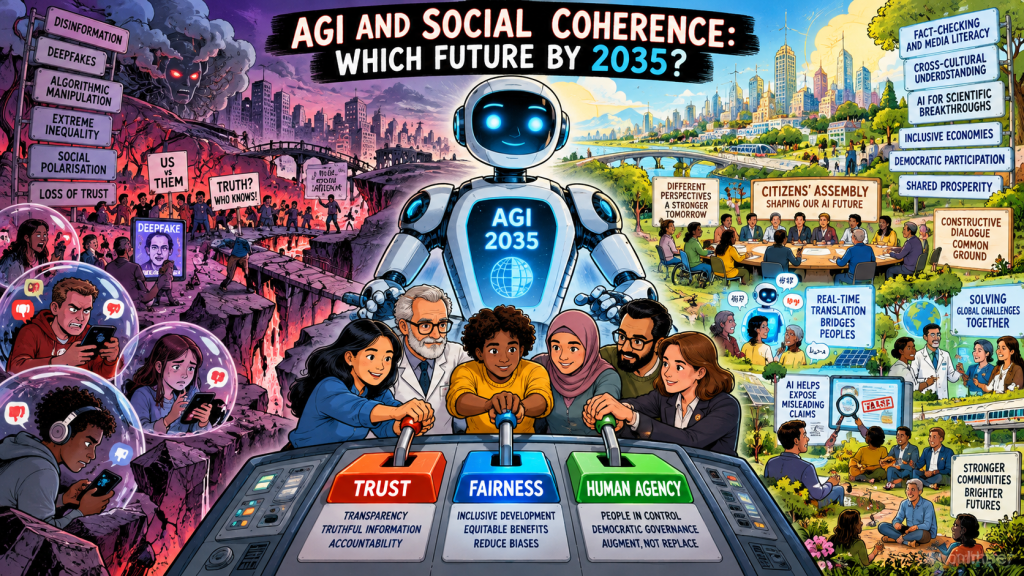
That’s the question behind a major new Real-Time Delphi study conducted by the Millennium Project – where I serve as co-chair of the UK Node.
If you believe that you have good insight on future AI–AGI impacts on social coherence, consider joining this survey. Here’s a link to get started.
The Millennium Project describe survey participation as follows:
You do not have to fill out the whole questionnaire on one visit. You are encouraged to come back to read other panelists’ comments, and edit your own at any time until the deadline of December 15, 2026. Register for the survey using a social account or email address. If you choose email, you will receive an access code. When returning, please make sure to log in with the exact same account you used to register. The demographic questions are only asked once; you will not see them again when you return.
All comments are anonymous; no attributions will be made. However, if you want a specific comment attributed to you in the final report, include the tag [please attribute] within your text. Do not type your name in the comment box.
The results will be used to create alternative scenarios that will be given to The Millennium Project Node Chairs and Co-chairs around the world as inputs to the national workshops on these issues. The strategies recommended by the workshops to address future AGI impacts on social coherence will be the subject of additional RTDelphi studies to assess their effectiveness. All phases of this research will be combined into a report that will be sent to you and distributed to political, business, academic, NGO, and UN leadership around the world.
One very useful aspect about the survey is that you can give thumbs up or thumbs down votes to the explanations provided by previous respondents. (These responses are presented as anonymous, so it’s usually not obvious who wrote each one.) You can also revisit the survey at a later date to revise your own assessments in light of the comments provided by other participants.
My personal view is that 2035 is too far into the future… and that the question of whether AGI will have a good or bad impact on human wellbeing will be determined long before then. But, hey, don’t let my opinions influence how you provide your own answers to the survey!
// David Wood – Chair, London Futurists


