Dear Futurists,
Big claims have been made regarding a meeting that took place in Geneva on 6th and 7th of July.
Did that event – a UN global dialogue on AI governance – live up to its billing?
That’s one of the topics covered in this newsletter – along with updates on other projects or events which I hope will be of interest.
1.) AI Governance – First Global Dialogue Unpacked

The following comments were made on behalf of the EU and its member states by Mr. Roberto Viola, Director-General for Communications Networks, Content and Technology, in the European Commission.
This Global Dialogue on AI Governance is a unique moment – this is the first time that all members of the United Nations gather to discuss AI governance in a dedicated meeting.
He went on:
A successful first Global Dialogue can lay the foundation for greater international cooperation on AI. It will have to base AI discussions on a credible, independent scientific baseline and thus create the conditions to avoid a race to the bottom, whereby technological advances are pursued at any cost.
Tomorrow, Wednesday 29th July, from 2pm UK time, I’ll be moderating a GAIGANow conversation that unpacks that Global Dialogue. Among other questions, I’ll be asking:
- What were the most significant developments at the first UN Global Dialogue on AI Governance?
- What was missing or under-represented during the Dialogue?
- What are credible next steps, ahead of follow-up meetings scheduled for New York (May 2027) & Geneva (June 2027)?
We’re fortunate that a truly distinguished panel will be joining us:
- Professor Maria Joao Rodrigues, a Portuguese academic and politician who served as Minister of Employment in Portugal under Antonio Guterres. A former Member of the European Parliament, where she was Vice-President of the Group of the Socialists and Democrats, she has also acted as a special advisor to a number of European and global politicians and is now the Chair of the Advisory Board of Reimagining Europa.
- Dr Supheakmungkol Sarin, Research Director of AI Safety Asia. Prior to joining AI Safety Asia, Mungkol worked at the World Economic Forum, where he served as the Head of Data and AI Ecosystems, playing a pivotal role in establishing the AI Governance Alliance, co-leading the Safe Systems and Technologies initiative, and spearheading the inaugural AI Governance Summit.
- Robert Whitfield, Convener of the Global AI Governance Alliance (GAIGANow). A former Senior Vice President of Airbus, with extensive experience in civil society, he is Chair of the Transnational Working Group on AI of the World Federalism Movement and Chair of the One World Trust.
- Stuart Russell, professor of computer science at the University of California at Berkeley. In 2016 he founded the Centre for Human-Compatible Artificial Intelligence at UC Berkeley. He is one of the world’s leading advocates for safe and equitable AI and is President of the International Association for Safe and Ethical AI.
You can register here on Zoom to attend this webinar.
Or see this London Futurists page for some extra details.
Please be aware that, due to (most likely) finger trouble on my part, some of the Zoom registration emails for this webinar wrongly gave the start time as 2:15pm UK time. The correct start time is 2pm UK time.
2.) 17 speakers announced for 19-20 September
I’m pleased to confirm that the number of eminent thought-leaders and provocateurs who have kindly agreed to speak at our two-day event The Technoprogressive Opportunity The future of ethics and emerging technologies keeps rising. As a reminder, the event will be taking place at the LSBU Hub on 19th and 20th September.
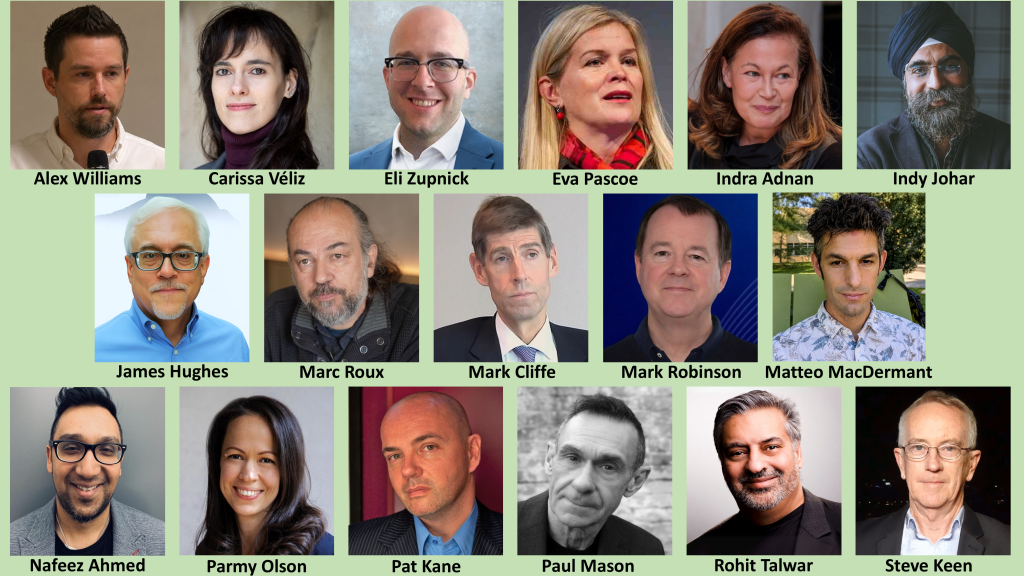
You can read more about these speakers here – and this is the Luma page for the event.
Please share the Luma page among your own friends and colleagues, to encourage them to register and attend!
I confess I’ve received some adverse feedback about the AI-generated image I was previously using to illustrate this event. I’ve gone back to the AI drawing board and have now switched to this image instead:
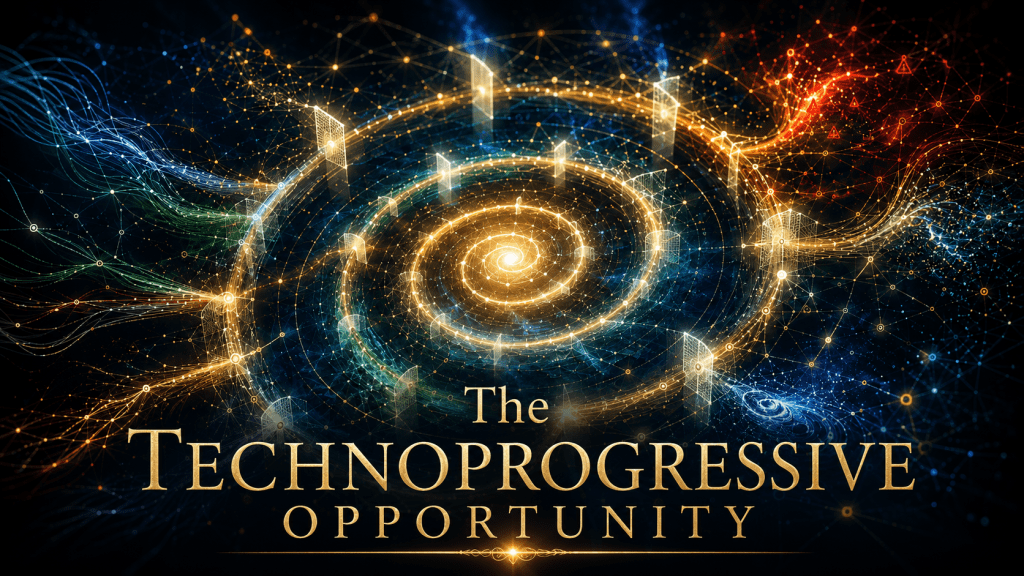
In case you’re curious, this is from the prompt used to generate the new image:
This image – a broad spiral with branching connections – depicts a growing technoprogressive current.
As the spiral expands, it encounters increasingly complex outer regions: denser networks, ambiguous structures, turbulence, competing currents, and darker zones.
This is no smooth inevitable ascent. Some pathways double back. Some branches terminate. Some are visibly rerouted after encountering instability. At several points, thin luminous “verification gates” cross the spiral, suggesting that greater capability is admitted only after scrutiny.
The image contains multiple distinct streams entering from different directions and joining the spiral without losing all their individuality. This represents pluralism, distributed participation, dissent, institutional diversity, and the principle of “by everyone, appropriately coordinated”.
The overall movement is from uncertainty toward earned trust and coherence, but without reaching a perfect final utopia. The outermost region remains open-ended.
3.) Technoprogressive Worldbuilding, with Matteo Rossi MacDermant
The most recent London Futurists Podcast episode features one of the speakers who’ll be presenting his ideas at our conference on 19-20 September: Matteo Rossi MacDermant, a technophilosopher from the University of New Mexico.
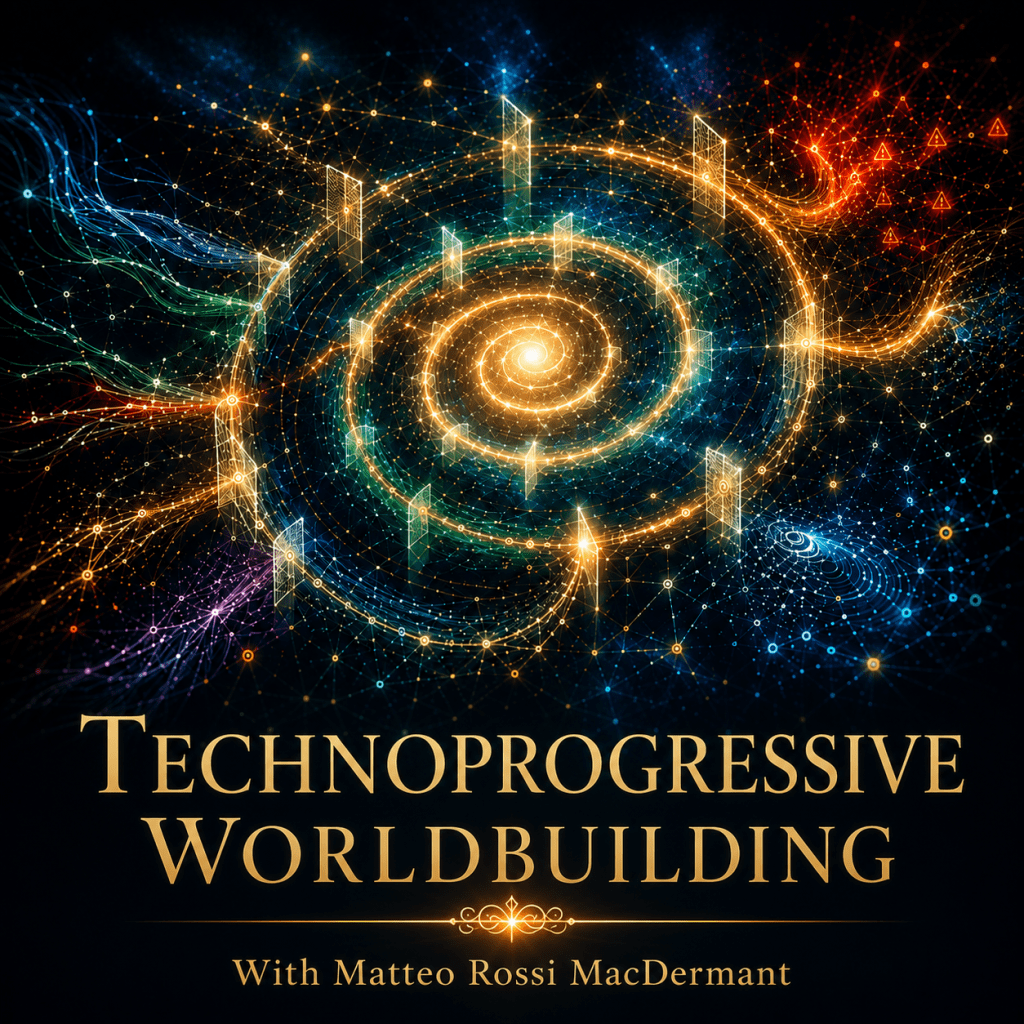
Matteo hosts a show called Bread and Robots, which covers subjects such as post-scarcity economics, universal basic income, the tech workers movement, and how technology can be steered toward collective abundance rather than corporate exploitation.
Matteo is also the instructor for an online course called “An introduction to technoprogressive worldbuilding”.
You may ask: what is technoprogressive worldbuilding? That was the question at the start of our conversation. Here’s the short answer:
Technoprogressive worldbuilding goes beyond envisioning and applying technologies to boost individual freedoms. It’s also concerned with the role of technology in improving social institutions, cities, shared energy systems, space policy, universal basic capital, and much more.
The conversation went on to consider several ways in which the transition of the economy to one of global abundance could be derailed by adverse political headwinds, largescale unemployment, crises in housing, healthcare, healthspan inequality, leading to wide social catastrophe. We also reviewed pros and cons of ways to avoid any such derailment, including universal basic income, universal basic capital, a land value tax, and ensuring that society’s resources are being applied to the tasks that are most important.
You’ll find the entire episode here, as well as on all the usual podcast apps.
4.) Design commitments for trustworthy technoprogressive governance
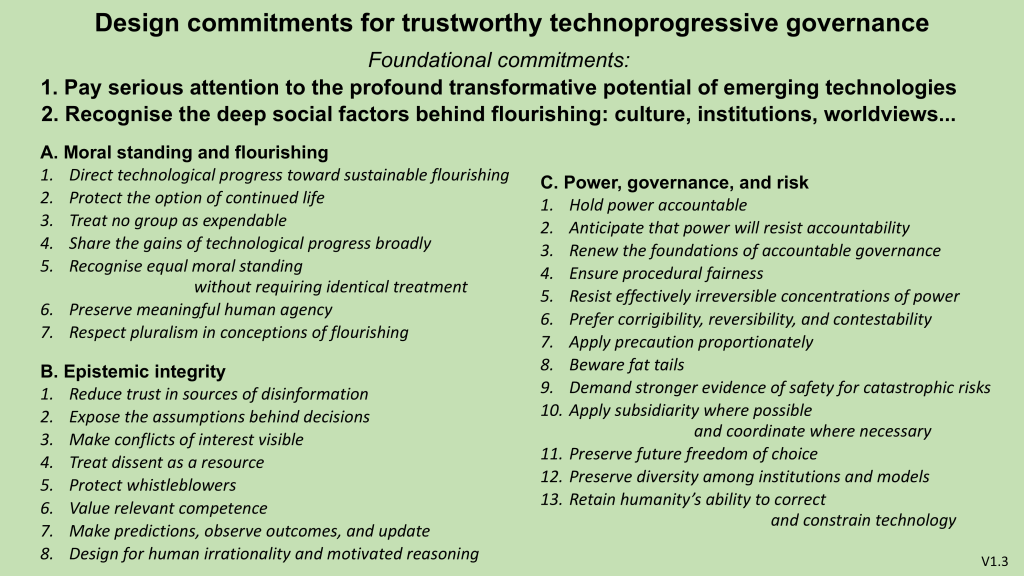
A few days ago, I published a major new personal blogpost. It’s ambitious.
What follows is a brief extract from near the beginning. I’ll be very interested in your feedback:
Traditional answers to the “who governs” question have fallen into disrepute. Elected politicians, nominated experts, market forces, vocal public opinion, self-declared strongmen, assertive theocrats, and advanced information technology systems – all of these have large question marks regarding their reliability and trustworthiness. And when people do come together, to try to bridge the wide gulfs that often separate them, the process is usually slow and frustrating.
In consequence, governance is proving increasingly ineffective and counterproductive – at a time where good global governance is especially needed:
- Emerging technologies are magnifying the scale, speed, and concentration of power.
- As a result, weaknesses in governance that were once tolerable are becoming increasingly dangerous.
To move things forward, I seek to identify a core set of commitments that might be adopted near universally – by people in all walks of life, from different cultural backgrounds, with diverse political outlooks, and with numerous opposing instincts and beliefs. These shared commitments will, if fit for purpose, provide the framework for better lives for everyone…
I offer them not just as a set of commitments that I personally aim to embody. Instead, I offer them as a candidate set of principles that could, in stages, build increasingly global consensus. By being adopted in ever larger circles, these commitments could inspire growing numbers of people to prioritise their actions in ways that will significantly boost constructive coexistence and overall flourishing.
5.) Our petition to consider Stewardship Democracy for the age of AI
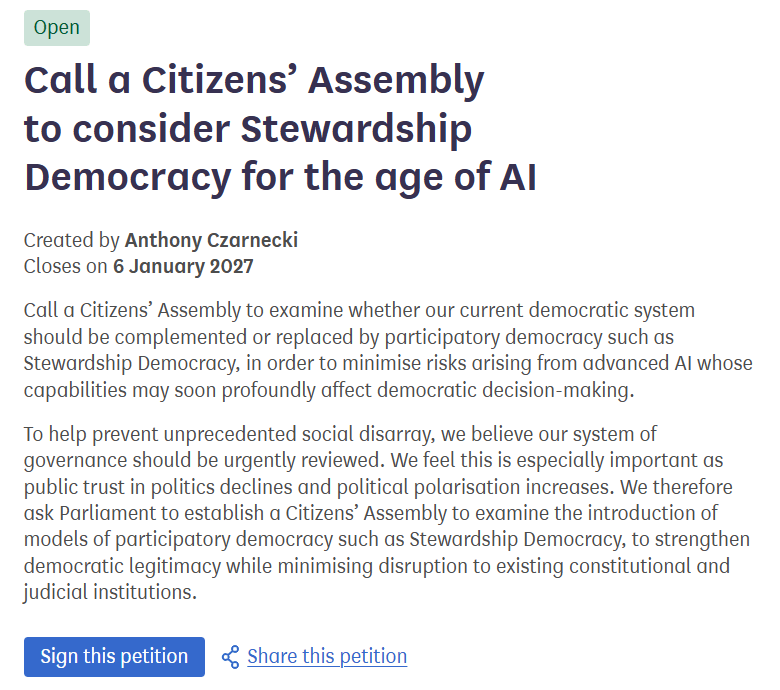
I’ll send with some more good news. The UK Parliament petitions website has accepted the petition created by Tony Czarnecki, long-time supporter of London Futurists.
You can read more about the petition here (London Futurists) and here (Sustensis).
You can find the petition itself here.
If you are registered to vote in UK elections, please consider signing the petition. And if you particularly like what it says, please spread awareness of it among your own networks!
// David W. Wood – Chair, London Futurists