Dear Futurists,
If you’re keen to exchange insights and explore scenarios involving potential near-term disruptions, you’ll find plenty of opportunities in this newsletter.
1. ) Lunch gathering with Brett King and Dr Julia Michelin

This Thursday, 14th May, we’ll be gathering in our usual pub venue, the upstairs room of Ye Olde Cock Tavern in London’s Fleet Street.
But instead of meeting in the evening, this time, as an experiment, we’re meeting over lunch, from 12 noon to 2pm.
The occasion is the visit to London by world renowned futurist Brett King and expert on the use of AI for preventing oral ill health, Dr Julia Michelin. Brett is the co-host of The Futurists Podcast, and Julia is the author of the book The Future of Dentistry: How AI will change everything.
Expect a free-wheeling conversation that is likely to include:
- The future of finance (Brett regularly talks about “Bank 5.0”)
- The future of politics (discontentment, alienation, new entrants, new coalitions, or what?)
- The future of geopolitics (what will happen when political leaders really waken up to the disruptions that AI is poised to cause?)
- The future of preventive healthcare (with a special focus on oral health)
- Any other topics that attendees believe deserve special attention.
There’s no charge to attend, but the venue provides the room to us for free on the expectation that most of the attendees will pre-order lunch, and will buy at least one drink when they arrive.
To secure your place at this gathering, you need to do two things:
- Sign up on this Luma page, and
- Fill in this Google Form to register your food pre-order.
Note that food pre-orders need to be submitted by Tuesday lunchtime.
2.) Cybernetics Society live online seminar
On Wednesday 20th May, starting from 5pm UK time, I’ll be the lead speaker at a live online seminar of the Cybernetics Society.
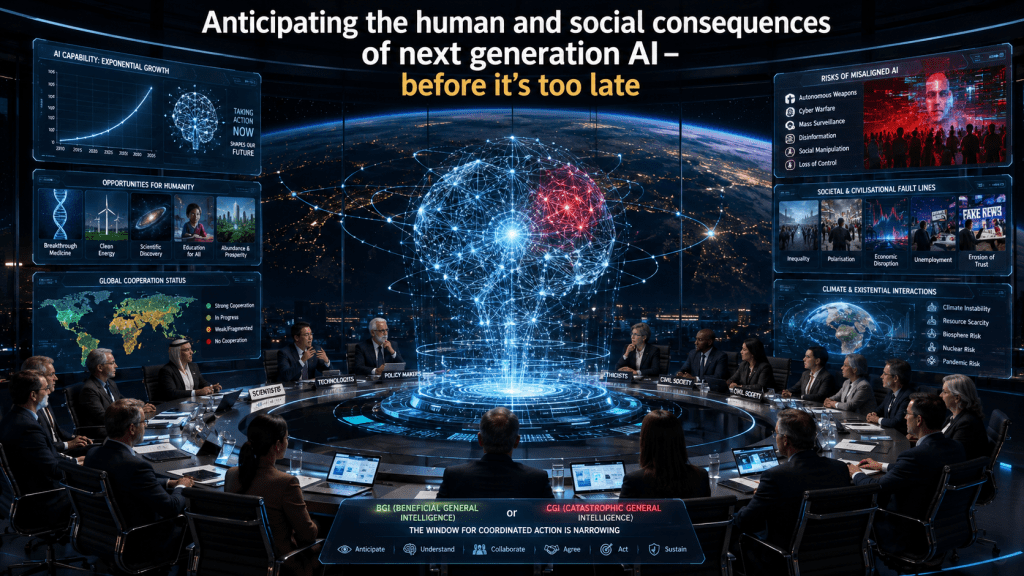
The subject of my presentation is “Anticipating the human and social consequence of next generation AI – before it’s too late”.
Here’s the abstract for what I expect to cover:
After decades of relatively slow progress, AI systems are now advancing rapidly, frequently surprising even their designers. This talk will:
(1) Review whether that pace of change will continue – or whether AI is about to reach a “wall”;
(2) Anticipate the range of deep problems likely to arise if insufficient guardrails are put in place, allowing misaligned AI to interact destructively with existing societal and civilisational fault lines;
(3) Explore options for reaching and maintaining global agreements so that next generation AI is a “BGI” (beneficial general intelligence) rather than a “CGI” (catastrophic general intelligence).
After my presentation finishes, there will be plenty of time for Q&A and wider discussion.
It’s free to attend. For more information and to register to attend, click here.
3.) Update on plans for The Technoprogressive Opportunity
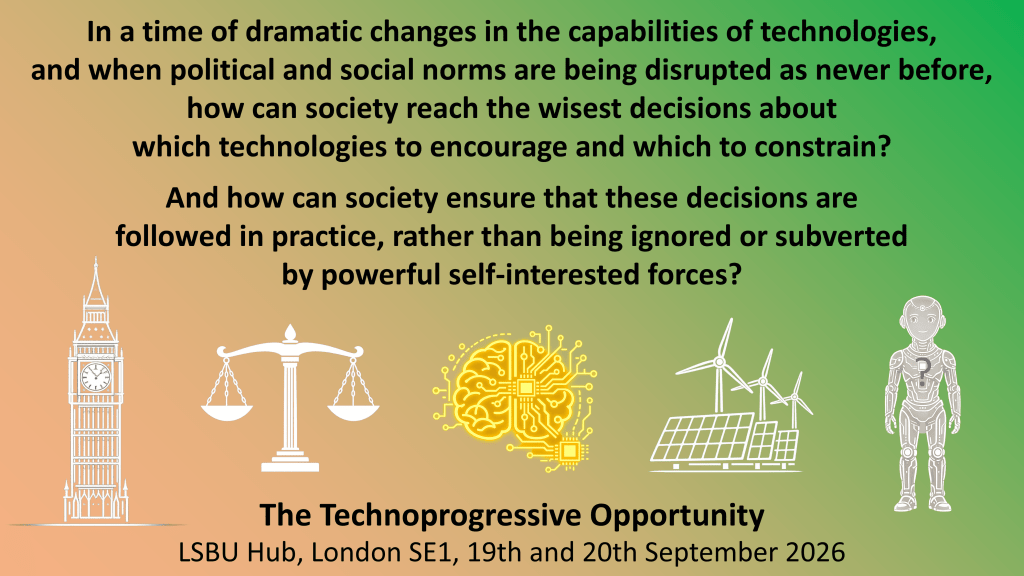
Behind the scenes, plans are progressing for a major two-day free-to-attend conference “The Technoprogressive Opportunity: The future of ethics and emerging technologies”, taking place at LSBU Hub in London on 19th and 20th September.
This conference is being co-hosted by IEET (Institute for Ethics and Emerging Technologies) and London Futurists.
Nine excellent speakers have already agreed to take part (and will soon be announced), covering a variety of important technoprogressive issues; and discussions are underway with a number of other potential speakers.
As well as presentations and panel discussions, these two days will provide a rich opportunity to strengthen personal relationships, deepen insights, and take concrete steps forward in building the technoprogressive coalition.
For more information, and to register to attend, see here.
4.) The Economic Singularity subseries in London Futurists Podcast
After a break of several months, London Futurists Podcast is back, with a new subseries of episodes on what has been called the Economic Singularity – the idea that economic relationships will experience an unprecedented transformation in the wake of the wide adoption of general purpose AI:
- It’s not just that most employees will have to rapidly retrain with new skills, in order to retain their position in the economic marketplace
- It’s that the majority of people will become unable to earn a living, since hardware and software machines will be able to out-compete them in every occupation (including new occupations that are created in the wake of AI)
- This means that most people will no longer earn an income, so governments finances from income tax will collapse
- This also means that people will lose their present political power of being able to threaten to withdraw their labour.
The first two episodes in this new subseries have both received strong positive feedback:
- Windfall Trust and the Economic Singularity, with Adrian Brown
- Post-labour economics and the future of capitalism, with Ted Shelton
Look out for more episodes coming soon!
Aside: for an extended analysis of possible “solutions” to the Economic Singularity, see this essay of mine from 2024, “Disbelieve? Accept? Resist? Steer? Simplify? or Enhance?”
5.) Some recent videos you may have missed
I’ll finish by providing links to three recent videos you might have missed, which you may enjoy watching:
“Talking about catastrophic and existential risks: Dos and Don’ts” – featuring John Sherman, Hannah Betts, and Anthony Bailey
“Transhumanism and human flourishing” – featuring Tracy Trothen and me, David Wood
“Resurrecting Humanity in the Age of AGI” – a conversation recorded on the Mindplex podcast for release on Easter Sunday, featuring Roman Yampolskiy and me, refereed by Mihaela Ulihero.
// David W. Wood – Chair, London Futurists


