
Dear Futurists,
It’s time to share a theme which will be guiding my plans for London Futurists in 2026: “From forecasts to levers”.
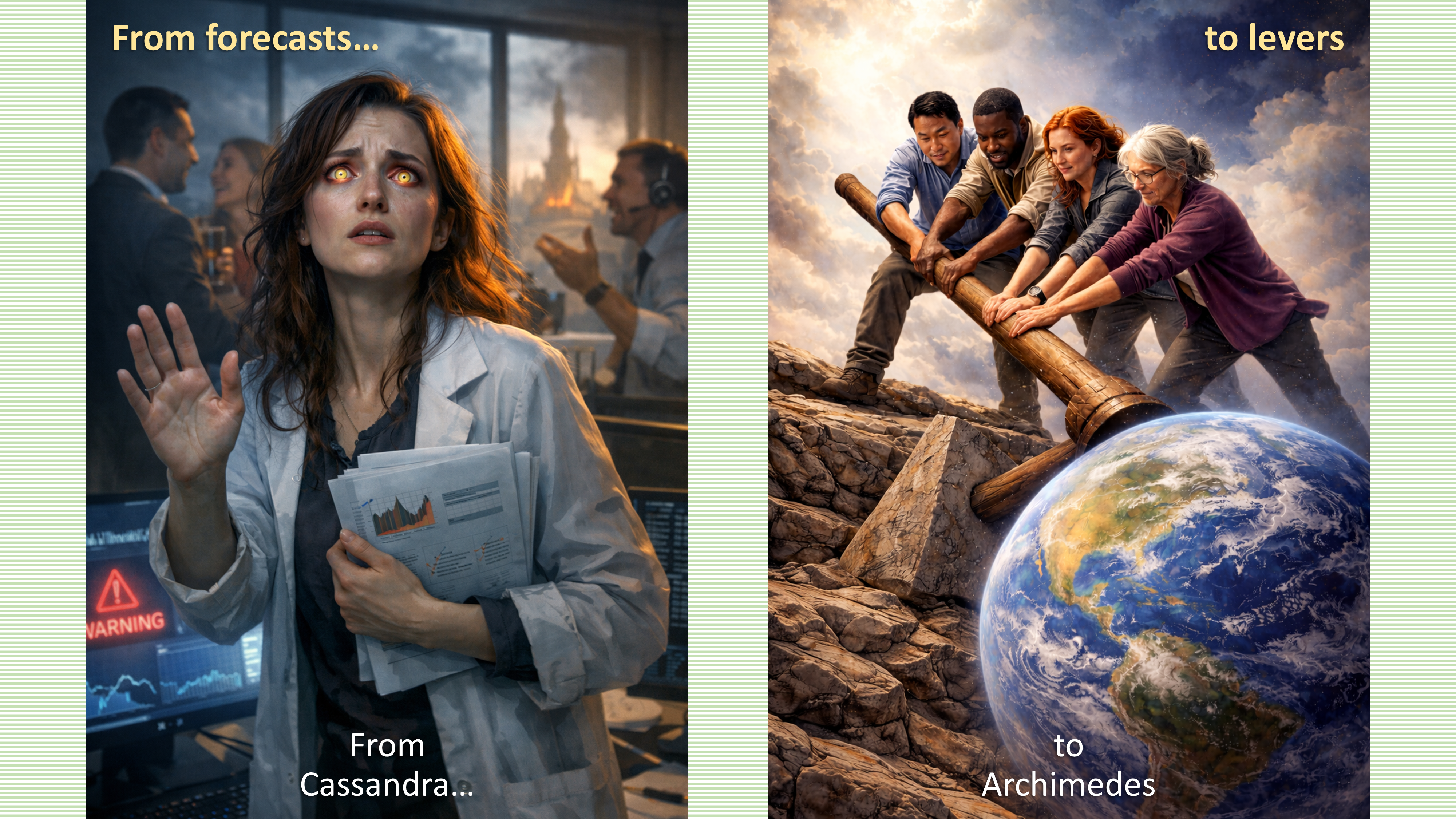
Here’s the context: As I see it, futurists and other practitioners of foresight have often created impressive-looking reports, which, nevertheless, have frequently failed to bring about meaningful improvements in the worlds of economics and politics.
Too often, we futurists are like the Cassandra of Greek mythology: we make forecasts about impending catastrophes, but no-one takes us seriously – even though our forecasts are backed up by lots of good analysis.
That’s my assessment. Not everyone agrees: various observers suggest that futurists have performed a useful task, overall. And I can’t deny that there are some important exceptions to my downbeat assessment. (I included a number of very positive examples in my 2021 book, Vital Foresight.)
So what leads me to be downbeat, as 2026 dawns? And how do I propose that, as the year proceeds, London Futurists can help to improve the practice of foresight? What are my suggestions that we can be less like Cassandra and, collectively, more like Archimedes, finding a suitable point of leverage to alter the trajectory of global civilisation?
Read on…
1.) “44 facts to start the year with optimism“

If you want to find reassurance that the world is actually getting better, there are plenty of facts that can fill you with good cheer.
Thus Kiko Llaneras, a data journalist for El País in Spain, published a Twitter thread on New Year’s Day containing “44 facts to start 2026 with optimism”.
Here are some examples:
- We live longer
- Fewer children die
- Extreme poverty has fallen
- Girls in secondary school rose from 47% to 68% since 2000
- Millions gained electricity
Further down the thread, #9 is “Renewables surpassed coal for electricity generation”. #24 is “Solar energy has tripled in seven years”. And #27 is “Projected emissions for 2040 are 40% lower than a decade ago”.
However, I share the assessment of F. Scott Fitzgerald:
The test of a first-rate intelligence is the ability to hold two opposed ideas in the mind at the same time, and still retain the ability to function.
The present time does have many features which show remarkable progress from the past. But it also has many features which raise deep concern. Both sets of trend co-exist. It’s our responsibility to include both sets of trends in our appreciation of future possibilities.
2.) Beyond naïve optimism
Three of the “44 facts to start 2026 with optimism” that I mentioned above relate to humanity’s increasing use of renewable energy, and a reduction on the greenhouse gas emissions expected for 2040.
However, despite this progress, the quantity of greenhouse gases emitted each year continues to increase!
We should avoid being misled by happy talk that the rate of increase has slowed. The point is that the actual emissions are continuing to rise.
Moreover, even if emissions decline, there’s still more than enough greenhouse gases in the atmosphere – including long-lived ones such as methane – to keep increasing the global temperature toward dangerous thresholds.
Adding further to the challenge, it’s unclear how close the environment is to tipping over from a broadly linear pace of temperature increase to a much more disruptive surge in temperature. Indeed, a report published late last year warns that
The world has entered a new reality. Global warming will soon exceed 1.5°C. This puts humanity in the danger zone where multiple climate tipping points pose catastrophic risks to billions of people.
I base this part of my assessment on some very clear writing by Mike Berners-Lee in his penetrating book A Climate of Truth: Why We Need It, And How To Get It.
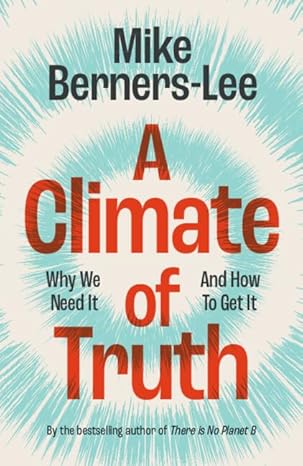
With its hard-hitting analysis, the book peels back the layers of the wicked onion of troubles we are all facing, explaining why decades of previous activities (30 COPs and counting) have failed to reduce the amount of greenhouse gases being emitted.
I have read literally scores of books on climate catastrophe over the decades, but this one is particularly plain-spoken, cogent, authentic, and persuasive. It left me with many new realisations.
Although the author has a deep interest in climate change, his analysis applies more broadly. His conclusion is that the root problem preventing real progress on many fronts is the culture of dishonesty and deception which increasingly plagues our politics, our media, and our business culture. The outcome is inaction over the greatest threats humanity is currently facing – an accelerating climate catastrophe, loss of control over technology (especially AI), and more.
The book provides many reasons for pessimism, as it punctures numerous delusions which people often use to comfort themselves that things aren’t that bad really. But the book provides many reasons for optimism too, namely actions we can each take, individually, and collectively. I’ll turn to some of these shortly.
But first, let me mention several other reasons for strong frustration with how global decisions are being made at the present time:
- Political discussion is increasingly driven by what Tim Urban astutely describes as destructive “low-tier thinking” (on both the progressive and conservative wings of debate) rather than constructive “high-tier thinking” (he makes this argument in his excellent 2023 book What’s Our Problem?)
- Society seems incapable of applying its resources on matters of fundamental importance, preferring instead to fritter away opportunities on mediocrity, distraction, petty favouritism, or other short-sighted slop (thus, in The Big One: How We Must Prepare For Deadly Pandemics, Michael Osterholm and Mark Olshaker justifiably lament our collective failure to learn vital lessons from the many dropped balls before and during the deadly Covid pandemic)
- The management of many Big Tech corporations often seems to be full of what ex-diplomat and long-time Facebook employee Sarah Wynn-Williams has called “Careless People” (even if there’s considerable exaggeration and self-justification in Wynn-Williams’ book with that name, it still presents an alarming culture within the company’s leadership)
- The kind of respect for fundamental legal principles championed by far-sighted US lawyers at Nuremberg, after the Second World War, is being trampled into the dust by a resurgence of expedience and “might makes right”
- Despite some optimism that wars should be a thing of the past and that (as argued by Steven Pinker) violence is declining, huge numbers of people are suffering from far too many conflicts around the world.
Many of these failures have been forecast over the years by futurists. But our warnings, far too often, have gone unheeded.
That’s why we futurists need an honest self-reassessment.
3.) How can better foresight actually improve the world?
My search for actionable levers, rather than simply for more forecasts, is what motivated the organisation of the forthcoming London Futurists Webinar on Saturday 17th January, “How can better foresight actually improve the world?”
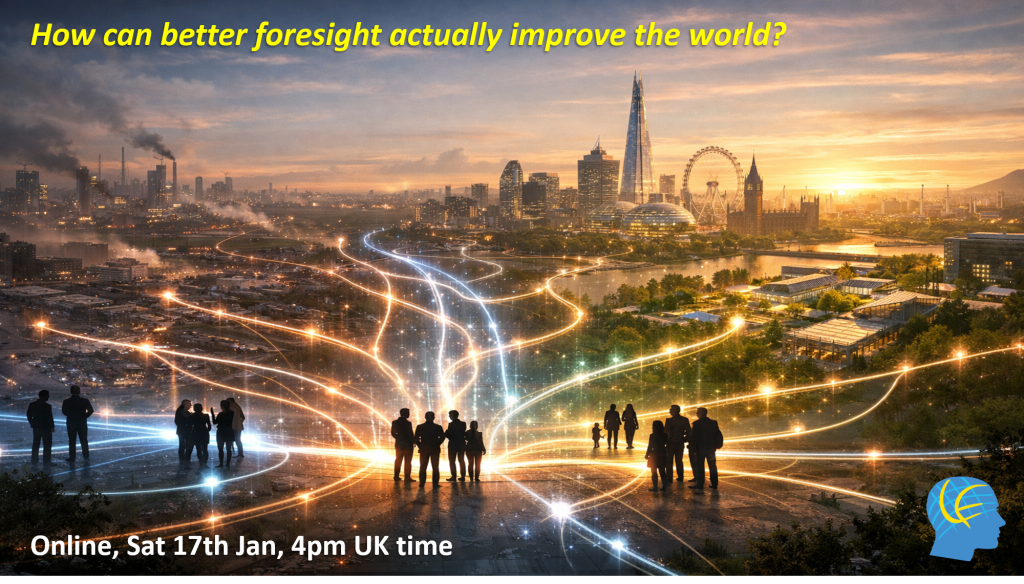
In this webinar, a panel of four independently-minded futurists will be offering their opinions on what’s often been missing from previous foresight activities – and how foresight could have greater positive impact if done better:
- Rohit Talwar: Global Futurist and CEO, Fast Future
- Margeret Heath: Independent interdisciplinary cybernetics researcher
- Guilhem Kuczynski: Independent metacognition specialist and narrative engineer
- Isabel Serval: Foresight Strategist and Futures Provocateur, Traversing Futures
Topics that I expect may feature in the conversation include:
- The wider set of methods and processes that the discipline of foresight can deploy
- Technological tools that can improve decision-making and adaptive responses
- The transformative power of narrative
- Options for enhancing the effectiveness of global institutions
- Past examples of when good foresight did improve the world
To conclude the event, plans will be made for follow-up events or projects with the same overarching general theme of “From forecasts to levers”.
For more details, and to register to attend (it’s free of charge), click here.
4.) Podcast: Anticipating 2026
On New Year’s Eve, Calum Chace and I met in the online RiversideFM studio to record the 127th episode of the London Futurists Podcast.

For this episode, it was just the two of us, picking out a number of events from the last 12 months which we see as potential signals of larger exponential impact ahead.
If you listen to our conversation, you’ll hear echoes of the same mix of optimism and pessimism – with an over-riding desire for action-orientation – that I’ve indicated in previous sections of this newsletter.
You’ll also hear about some personal experiences, of the sort that we don’t normally talk about on the show.
Some of the developments we anticipated for 2026:
- AI models will keep on improving (there’s no “silicon ceiling” in sight)
- AI agents will be in wider use – and will need more sophisticated testing ahead of deployment
- AI models will power new waves of cyber attacks
- More people will experience status dissonance due to: the pace of change, AI-generated misinformation, and loss of jobs.
On the potential good news front, we also anticipated:
- The application of AI to accelerate biochemistry and rejuvenation treatments
- More generally, a superabundance of energy, food, goods, and services, in which it will be like everyone “retiring rich” or “being on a full-time vacation”…
….but that’s providing society can navigate through the turbulence of the Economic Singularity, agree processes for distributing the fruits of abundance worldwide, and ensure these processes will be followed by the owners of AI businesses who will have unprecedented wealth and power.
The episode concludes by:
- Anticipating the acceleration of medical research with a society-wide “war on aging”
- With hopes for a parallel “war on populism”
- Envisioning the rejuvenation not just of physical bodies but also our key institutions and our mental wellbeing.
If you enjoyed listening to this episode, or any other of our podcast episodes this year, please consider giving us a five star rating (and, optionally, a short positive review) on your favourite podcast app. That will encourage AI algorithms to recommend the show to more listeners!
5.) Progress at LEVF
In case your interest is piqued by my mention above of “Anticipating the acceleration of medical research with a society-wide ‘war on aging'”, let me draw your attention to a year-end report I wrote for the Longevity Escape Velocity Foundation (LEVF).

Topics covered in that note include:
- News about Aubrai – a pioneering AI BioAgent created to accelerate longevity breakthroughs, trained on the research and insights of LEVF President and Chief Science Officer Aubrey de Grey, and integrated with decentralised science funding tools
- A summary of results from RMR1 and an update on the design of RMR2 – referring to two projects within LEVF’s flagship RMR (Robust Mouse Rejuvenation) programme
- What makes LEVF different (and, ahem, deserving of wider support) from many of the more incremental approaches you can see elsewhere in the longevity space.
Watch out for more news on all these fronts shortly…
6) PauseCon 2 now scheduled for 21-23 February
If you have a particular interest in AI safety – in ensuring that advanced AI is truly beneficial rather than catastrophically dangerous – then please keep an eye on the PauseCon website.
Here are some excerpts:
Brussels: 21-23 February 2026
From Risk to Responsibility: Join the Strategic Summit for a Global AI Pause: A 3-Day Summit to Build Strategy and Drive Political Action at the Heart of the EU
The uncontrolled race for superintelligence continues, posing a significant risk of human extinction. But the political window to act is opening. This February, we are bringing our demand for a global, verifiable moratorium to the place where European law is made: Brussels.
PauseCon 2 is not a typical conference. It is a high-impact, 3-day strategic summit designed to move the needle and position the European Union as a global initiator for an AI Pause.
This event is not just about training, it’s about real-world impact. If you are ready to move beyond discussion and contribute to tangible political change, this is your event.

In short, the event is a great chance to understand how to find and use levers!
7.) Are you a fan of Discord?
I’ll end with a short note that a new Discord Server for London Futurists is under development.
The design is still at an early phase, and participation is deliberately being kept in small numbers for the time being.
But if you have:
- Good experience in the practicalities of Discord
- An enthusiasm for helping people to gain value from participating in well-designed Discords
- A general interest in strengthening positive collaboration within the extended London Futurists community
…then please get in touch, and I can add you to the current pre-release trials.
// David W. Wood – Chair, London Futurists


 London Futurists