Dear futurists
The world is full of remarkable change – some of it awe-inspiring, some of it deeply concerning.
Yet we often find ourselves surrounded by what might be called “worldly wisdom”, or “mediocre futurism” – claims that:
- Despite the hoopla of hype, the future will be pretty much like the past
- We are powerless to change the future
- It’s foolish to get our hopes up, that we can influence the future
- The future is someone else’s problem – we should concern ourselves, instead, with the here-and-now.

Via London Futurists, my intent is to challenge that dismal narrative. I try to organise events, and to draw attention to other initiatives, which can help all of us to transcend mediocre futurism with foresight that is informed, engaging, energising, and transformational.
Read on for some opportunities, to surround yourself for at least a period of time, with thinking that draws attention to credible options for making a significant positive difference in the real world.
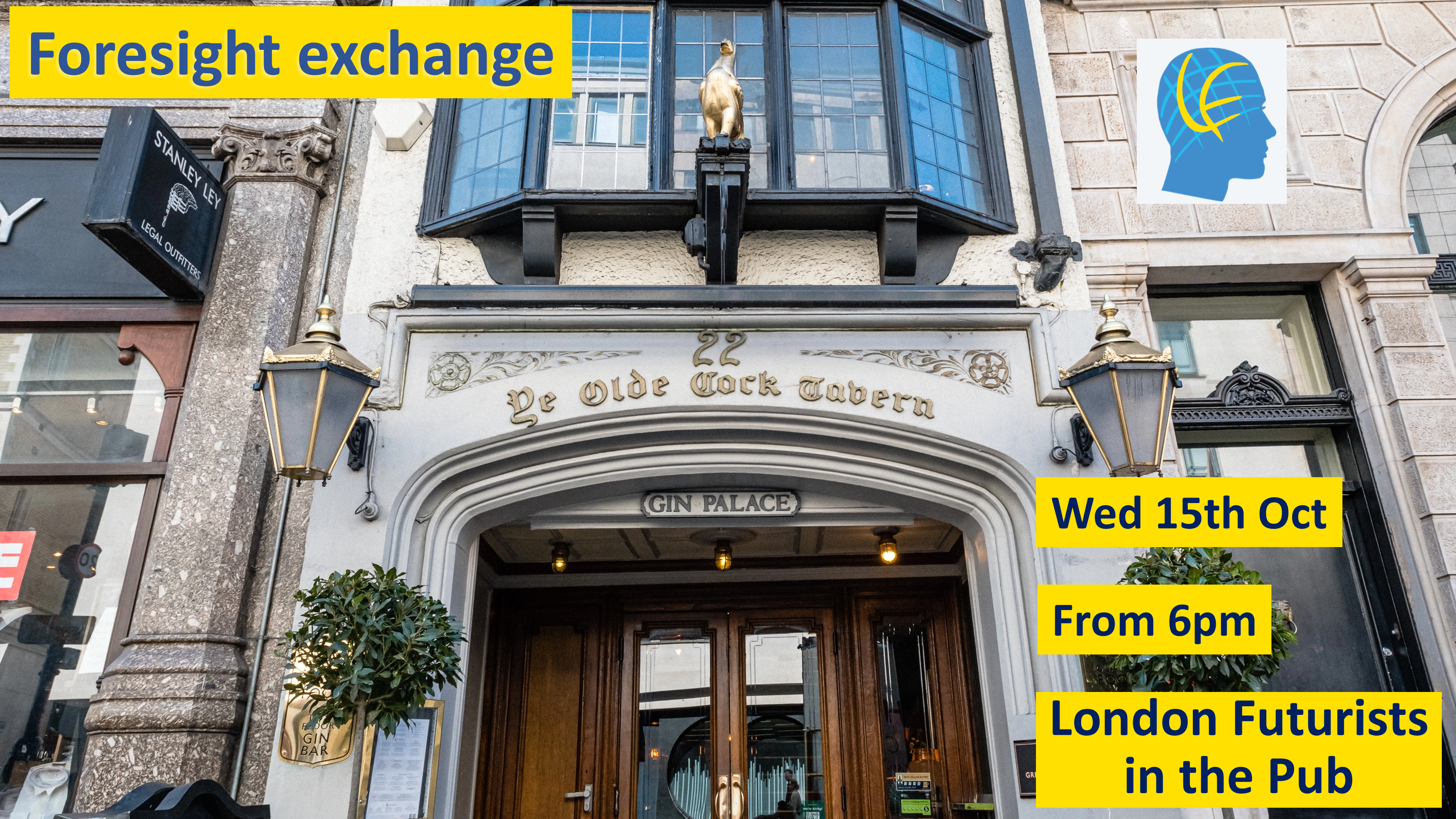
1.) Foresight exchange – Futurists in the pub, Wed 15th October
This Wednesday, 15th October, a number of members and friends of London Futurists will be gathering in Ye Olde Cock Tavern, in Fleet Street in London.
The venue has kindly agreed to make our usual room available for our use. This is the large room up the front stairs of the pub. The venue provide this room to us with the expectation that at least around 20 of us will gather there, and will all order at least some drinks, and possibly some food too.
Attendees of our recent previous in-the-pub gatherings have told me how much they appreciated being surrounded by people who take the future seriously: understanding that a large landscape of significant changes lies ahead of us, and that there are many options for us to shape that landscape, via our individual initiatives or collective activities.
On this occasion, there is no specific theme, apart from this description:
Which insights about possible near-term future scenarios deserve greater attention?
What are the tools, the sources of energy, the breakthrough technologies, the new operating models, the emerging campaigns, the creative thought patterns, the silent dangers, or the hidden stores of treasure, that people should be talking about more?
If there is something particular you would like to talk to the group about, please let the organisers (Tony Czarnecki or myself, David Wood) know in advance.
Here’s the rough schedule:
- 5:30pm: The room is available, for early get-togethers
- 6pm: Food is served; informal conversations
- 6:45pm-8:30pm: Sets of short talks or moderated group conversation, interspersed with opportunities to visit the bar downstairs
- 8:30pm: Informal networking continues
For more details, and to RSVP to let people know you plan to attend, please visit this meetup page.
2.) Here Comes The Sun, by Bill McKibben

I’ve recently finished listening to an audiobook that left me in an unexpected upbeat mood.
I found Here Comes the Sun: A Last Chance for the Climate and a Fresh Chance for Civilization to be a wonderful mix of grounded optimism and cautious realism. It’s written by Bill McKibben, who has been worried (with good reason) for four decades about risks of escalating global warming. But the book surveys recent game-changing improvements in solar and wind technology.
People have advanced many arguments why solar and wind power will be insufficient to head off catastrophic climate change. Until recently, these arguments have seemed strong. But McKibben’s new book shows how much has changed with improvements in the technology and distribution.
For example: Until recently, I thought that batteries and grids still lagged far behind the requirements to convert most of our electricity and heating to sun and wind. As McKibben explains, these shortfalls, too, are being made up fast.
Again and again while listening to this book, I found myself thinking – “of course, this is such a clear explanation”. So, indeed, my optimism has increased, that we humans can set aside our addictions to dirty energy sources, sufficiently quickly.
But McKibben is a realist too. His book includes examples of the terrible damage that is already resulting from unchecked climate change. And he chronicles the fierce resistance and devilish skulduggery that proponents of the status quo apply in protection of their profit streams.
In other words: whilst a wonderful solar-powered future is within our grasp, we’re not going to reach it without skilfully combatting the torrents of disinformation and cronyism that keep finding new ways to sow doubt about the costs, sustainability, and scalability of solar.
Some parts of the book are perhaps indulgent and unnecessarily discursive. But I see these parts as illuminating the human dynamics of the drama. And given the seriousness of the topic, occasional doses of light relief are welcome.
If you’re still unconvinced about the scale of the dangers of the energy status quo – or if you’re pessimistic about what solar and wind power can accomplish – then I strongly recommend this book to you. As the subtitle says, this could be “A Last Chance for the Climate and a Fresh Chance for Civilization”.
3.) Some highlights from TransVision Madrid
I recently had the pleasure to participate in two conferences in Madrid – including TransVision 2025.
Recordings of three of the talks there were recently shared by the U.S. Transhumanist Party, in one of their weekly virtual enlightenment salons:
From the description of the recording:
Dr. José Cordeiro provided an overview of the TransVision Madrid conference, the role of Spain in advancing healthy longevity, and how the history and trajectory of technological advances can bring about “Vita Plus Ultra” – “life far beyond” current limits.
Dr. Aubrey de Grey provided a presentation entitled “Where do we stand?” – highlighting the current status of the quest to reverse biological aging through the damage-repair approach, including key insights from the Robust Mouse Rejuvenation Study #1 (RMR1) and the major objectives of the RMR2 study for which the pilots are now underway.
David Wood presented on the Longevity Dividend and the Longevity Dividend Paradox – why correct arguments about the massive economic benefits of greatly extended longevity have not yet led to significant political support for rejuvenation research – and how that paradox might be overcome.
I trust that you will enjoy browsing through these recordings.
4.) Options for the Future of the Global Governance of AI
Another recording that you may value watching is from the London Futurists webinar on 4th October, “Options for the Future of the Global Governance of AI”. That featured an excellent set of panellists:
- Sean O hEigeartaigh, Director, AI: Futures and Responsibility Programme, University of Cambridge
- Kayla Blomquist, Director, Oxford China Policy Lab
- Dan Faggella, CEO and Head of Research, Emerj Artificial Intelligence Research
- Duncan Cass-Beggs, Executive Director, Global AI Risks Initiative
- Robert Whitfield, Convenor, GAIGANow
- Nora Ammann, Technical Specialist, Advanced Research and Invention Agency (ARIA).
Despite the profound challenges that the conversation covered, the webinar left me with a wave of optimism, that a large number of well-informed people are collaborating, around the planet, on key elements of what could become a comprehensive solution to AI safety.
Let me know if you agree!
5.) The latest from London Futurists Podcast
If you’ve not already listened to the last few episodes of London Futurists Podcast, here are some convenient links for you to click:
Episode 122: Safe superintelligence via a community of AIs and humans, with Craig Kaplan
Episode 121: How progress ends: the fate of nations, with Carl Benedikt Frey
Episode 120: Tsetlin Machines, Literal Labs, and the future of AI, with Noel Hurley
Episode 119: Intellectual dark matter? A reputation trap? The case of cold fusion, with Jonah Messinger
6.) Oxford: Transhumanism, human enhancement, and radical longevity
If you’re in or near Oxford on Friday 17th October, please consider attending the Oxford Biohacking Society event early that evening, where I will be the speaker. My subject will be “Transhumanism, for human enhancement and radical longevity”.
The Society has created this poster for the event:
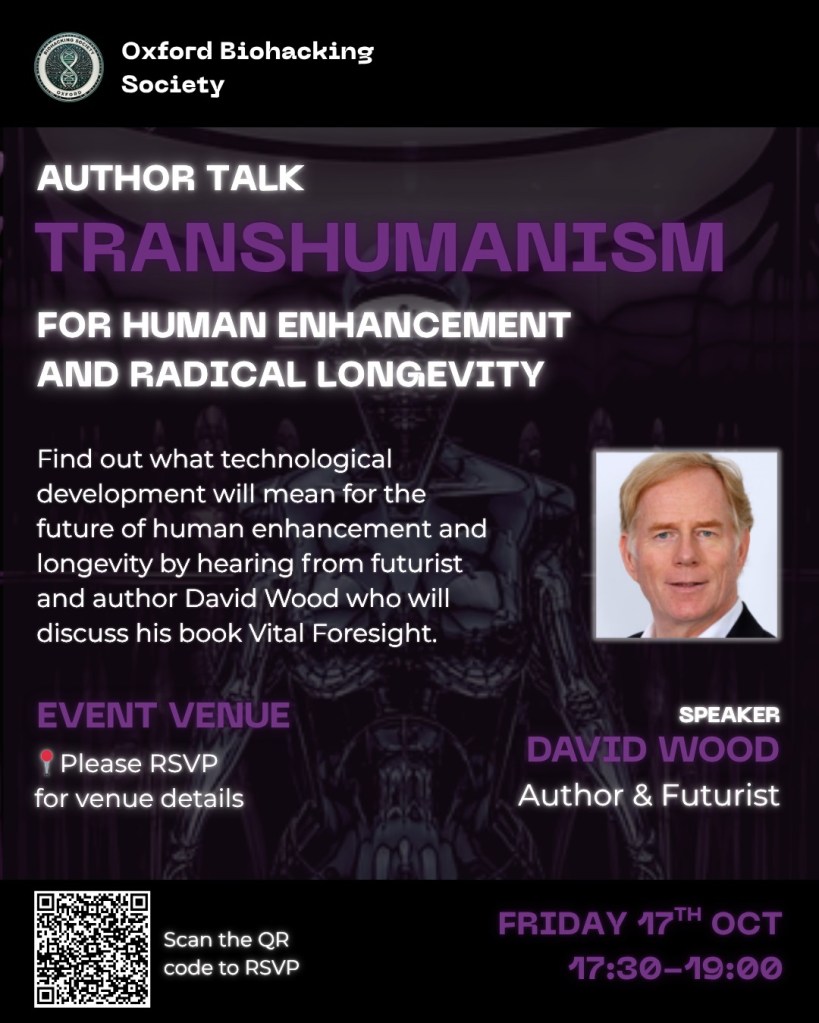
The QR code, if you scan it, will take you to this event registration page.
In line with the introduction to this newsletter, what I’ll be aiming to do in my talk in Oxford is to inform, engage, energise, and, yes, transform life trajectories.
After all, if we keep doing what we’re presently doing, the future will be created by others; we’ll just be the recipients of what is likely to include disinformation, confusion, distraction, shallow vision, and selfish cronyism.
We should, and can, transcend that kind of mediocre futurism.
// David W. Wood – Chair, London Futurists


 London Futurists