
Dear Futurists
This is a short note to aggregate various suggestions for topics deserving a deeper investigation following up the wide-ranging discussion in our webinar yesterday (Saturday), “How can better foresight actually improve the world”.
If you missed that webinar – or you want to watch some of it again to refresh your memory – here’s a recording:
The suggestions were raised during the webinar itself, or in the informal online after-party, or in messages exchanged shortly afterward.
In each case, depending on the level of interest shown, we might choose to dedicate some or all of a forthcoming event (perhaps another webinar, or an in-the-pub gathering, or on the London Futurists Discord) to that topic.
In no particular order:
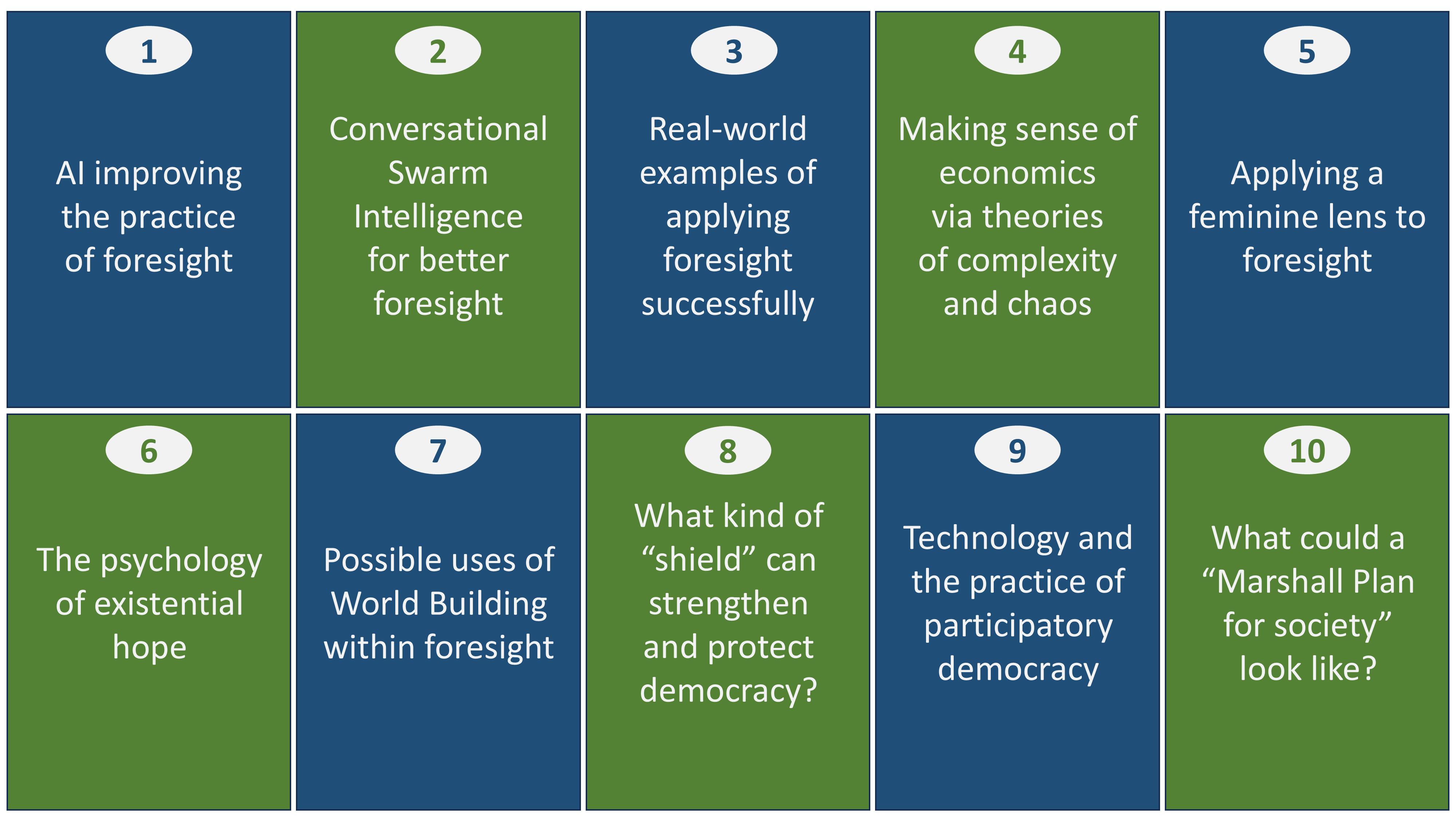
- How could the use of AI improve the practice of foresight?
- Conversational Swarm Intelligence (CSI) – as advocated by Louis Rosenberg of Unanimous AI (“Enabling real-time deliberative conversations at scale”)
- Real-world examples of how practice of various foresight methods were adopted by organisations, with positive effect – with a particular interest in methods involving systems thinking
- “Making sense of chaos: a better economics for a better world” using the systems thinking approach of Doyne Farmer
- What can applying a feminine lens to foresight teach us? Perhaps dive into “A Cyborg Manifesto” by Donna Haraway?
- The psychology of existential hope – How do we maintain agency and optimism when facing civilizational-scale challenges?
- Possible uses of the discipline of World Building within foresight
- What kind of “shield” is needed for democracy, to protect it against threats like foreign interference and disinformation?
- How can technology improve the practice of participatory democracy?
- What could a “Marshall Plan for Society” look like?
I apologise in advance for inadvertently omitting some of the suggestions that I ought to have included!
What next? I’m hoping to see some of you discussing these options on the London Futurists Discord, in the text channels and forums there, and/or in the voice+video “swarm” event scheduled there for 7:30pm UK time on Wednesday.
A word about Discord swarms:
I’m keen to amp our ability as a community to interact, discuss and ideate. To encourage more of us to head to Discord, we’re launching Discord swarms: focused, high-energy sessions where we tackle big topics together. Think lively debate, challenging ideas, and interaction – not passive consumption.
Here’s the plan: we’ll run these Discord swarms every Wednesday for 4 weeks starting 21st January, 7.30 – 8.30pm UK time, to get momentum going. After that, we may shift to less frequent events. Let’s see!
If this sounds like something you’d be interested in, I’m looking for:
- Suggestions for topics that push our thinking – controversial, unconventional, or just plain interesting
- Hosts willing to lead a session – you don’t need to be an experienced speaker, just someone with a passion for your topic and excited to share it with the group
If you’ve got a topic you’re fired up about or you’d like to host, don’t be shy. This is your chance to shape what we explore together.
As mentioned above, we already have the topic for the first one – a continuation of the theme “How can better foresight actually improve the world”. As for the subsequent events, I’m open minded. (We may run some online polls to gauge the level of potential engagement for various suggestions.)
Note: I appreciate that some of you may prefer Zoom/Google Meet/Teams to Discord. However, this mini programme isn’t just about exchanging ideas; it’s about community building and getting familiar with Discord. We may switch to other venues for our online weekly swarms at a later point.
// David W. Wood – Chair, London Futurists


 London Futurists