Dear Futurists,
In many ways, the world has never been better. But in many other ways, the world has never been riskier.
That’s the headline on the first main slide of the short scene-setting remarks I’ll be sharing at the start of the London Futurists live webinar this Saturday, “How can better foresight actually improve the world?”.
For a preview of these scene-setting remarks, and for news about two intriguing short videos created by Professor Bruce Lloyd, read on.
1.) A world laden with contrasting possibilities
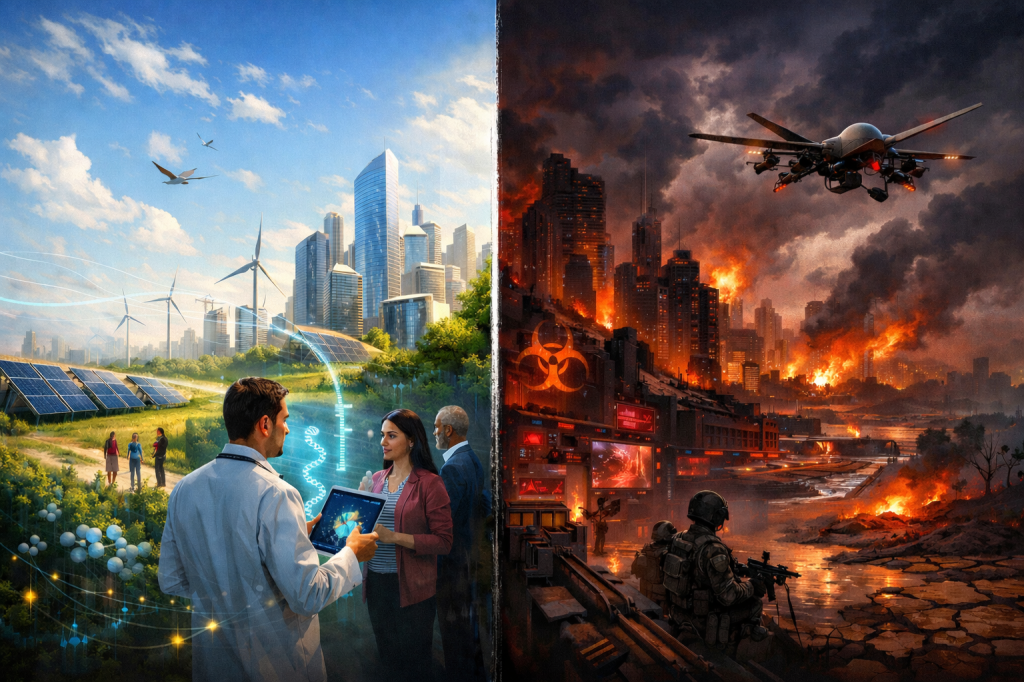
Here’s the text from the first of my main slides for Saturday’s webinar:
| The world has never been better | The world has never been riskier |
| Lifespans have increased significantly | The lessons of Covid not learned |
| AI is poised to enable new cures | AI is poised to enable bioterrorism |
| Unprecedented green energy from renewables (solar, wind, wave…) | Risk of runaway climate change after environment passes tipping points |
| Big Tech is creating huge value | Unstoppable reckless race to AGI |
| The economy at record levels | Cyberhacking at record levels |
| Widespread easy access to vast quantities of information | Widespread deluge of hate speech, misinformation, and distraction |
| Greater awareness of the nature of cognitive bias & other irrationalities | Greater prevalence of exploitation of cognitive biases and irrationality |
| Greater cultural diversity and international travel than ever before | Countries and terror groups willing to deploy deadly weaponry in new ways |
| Past scares have always turned out to be solvable by open human ingenuity | Liberal democracy being replaced by closed oligarchies (“power corrupts”) |
You may not agree with all my examples. You may think I have omitted some important cases. But I hope you’ll agree that, at least in broad terms, the world has moved forwards in many ways in the last few decades – whilst, in parallel, building up powerful pressing problems.
The second main slide of mine briefly makes the case that “Futurists and forecasters have contributed to envisioning and creating the positive developments”. That list names a few people who have acted, at least some of the time, as futurists or forecasters, and whose uplifting influence has spread far and wide.
The third main slide flips over to make this statement about the growing risks:
Futurists and forecasters have often warned about these possible developments, but our warnings have generally not been heeded
The slide then asks a series of questions:
- Why not?
- What have we said, which has caused the public to discount our recommendations?
- What have we failed to say?
- How can our interventions be more effective in the near-future?
- How can we transition from a group of Cassandras to a group of Archimedes?
At that point, I’ll be handing the mic and the screen to the four panellists who have prepared some responses:
- Rohit Talwar: Global Futurist and CEO, Fast Future
- Margeret Heath: Independent interdisciplinary cybernetics researcher
- Guilhem Kuczynski: Independent metacognition specialist and narrative engineer
- Isabel Serval: Foresight Strategist and Futures Provocateur, Traversing Futures
I’m anticipating a thought-provoking conversation – where we’ll be feeding in the audience questions that have received the most up-votes for other audience members.
For more details, and to register to attend this webinar, click here.
2.) Discord Debrief

I think I can make one prediction with some confidence: by the end of the webinar on Saturday, we won’t have reached unanimity on a comprehensive programme of clear tangible steps to improve the positive impact of the practice of foresight.
However, we will likely have generated a number of promising ideas – as well as raising the temperature on some unresolved controversies.
I’m therefore keen for this conversation to continue and to bring in additional voices.
One opportunity for this will be at a specially convened online voice+video gathering on the new London Futurists Discord.
That gathering will take place 7:30pm-8:30pm UK time on Wednesday 21st January. It is designed to be a chance for informal discussion that should be of interest:
- To people who attended Saturday’s webinar with the same headline title, and who want to continue exploring ideas raised there
- And to people who couldn’t attend that webinar, but who want to hear summaries of some of the main points shared there, before offering their own ideas.
Our Discord Server is still in a closed beta trial. Contact me to apply to join that trial and to be able to join the gathering on Wednesday.
3.) Two videos from Professor Bruce Lloyd
Professor Bruce Lloyd, a long-time friend of London Futurists, has responded to my question “How can better foresight actually improve the world?” by creating two short videos. He has done this by using Google’s remarkable NotebookLM AI tool, as well as a number of other AI systems.
Both videos are short and provocative.
The first is titled “Foresight Improves the World”, with the following description:
What if the best way to prepare for the future has nothing to do with predicting it?
OK, that claim may be a bit strong, but bear with the narrative in this short video. The video was created by Professor Bruce Lloyd on 4th Jan 2026 with the help of NotebookLM and several other AI systems.
As usual with AI, there are a few questionable aspects, but the video also raises a number of thought-provoking ideas.
The content includes:
- Beyond the Crystal Ball – Redefining the future
- The Tyranny of ‘Now’ – Our short-term systems
- Upgrading Conversations – How foresight works
- From Insight to Impact – Real-world benefit
- The Future is a Choice – From reaction to creation
The second is titled “Rethinking the Future”, with this description:
How do we take futures studies out of the realm of pure speculation, and turn it into something that can genuinely help us make better decisions right now? Is it all about disciplined, rigorous analysis, or is it more about a big collective conversation? When we talk about the future, are we just gazing into a crystal ball, making educated guesses, or can this be a real, credible discipline?
This video was created by Professor Bruce Lloyd on 13th Jan 2026 with the help of NotebookLM and several other AI systems.
It features and contrasts the ideas of two key thinkers from the history of foresight studies:
- Roy Amara, who the video calls “The Architect”, who argued for methodological rigour;
- Timothy Mack, “The Facilitator”, who argued for foresight as dialogue.
The video concludes by going meta, with the AI narrative offering a vision for how both these aspects of foresight can be transformed by AI.
If you have any comment on either video, you can submit them on YouTube – or join one of the London Futurists conversations.
4.) Plans for a larger in-person gathering
I’ve mentioned to several of you the possibility of an all-day (or possibly all-weekend) event at a central London venue where a number of different presenters and facilitators will help us explore diverse ideas on the general theme “Anticipating 2030”.

Previously, I thought this could be organised for as early as March. However, I have a lot of other projects which will need my close attention between now and March.
So I’m now considering a date early in May.
As I said, plans are still at a preliminary stage. A physical event like this requires a lot of organising – the venue, tickets, registration, speaker liaison, projection equipment, recording, etc. In contrast, online events have many advantages.
If you have any strong views about this, please get in touch!
// David W. Wood – Chair, London Futurists


 London Futurists