Dear Futurists,
1st November poses us all with a pleasant problem: three different events are taking place, simultaneously, on various aspects concerning the safe and beneficent usage of AI. We’re each going to have to make a hard choice that day.
I’ll list these options shortly. But let’s start with the day before, 31st October, where the decision what to attend is considerably easier.
1.) Stellar line-up for Wilton Hall
What is decided at the global AI Safety Summit at the UK’s Bletchley Park on 1-2 November may significantly influence our common future. Much is at stake!
Will the politicians, technologists, business leaders, and representatives from civil society gathered there, be distracted from the most important issues? Will they get bogged down in petty politics or virtue signalling? Or will they reach a clearer understanding of the landscape of major risks and astonishing opportunities posed by next generation frontier AI systems? Will they start work on practical measures that can be taken, individually and collaboratively, to steer the development and deployment of these systems toward safe, beneficial outcomes?
With these questions in mind, friends of London Futurists at Existential Risk Observatory and AI alignment solutions company Conjecture have organised a preview event at Wilton Hall, adjacent to Bletchley Park, on the afternoon (31st October) before the Summit.
A number of participants from the Summit itself will be in attendance at this preview event – as panellists or as audience members. It’s a chance for the rest of us to influence which ideas and insights they’ll take with them into the Summit.
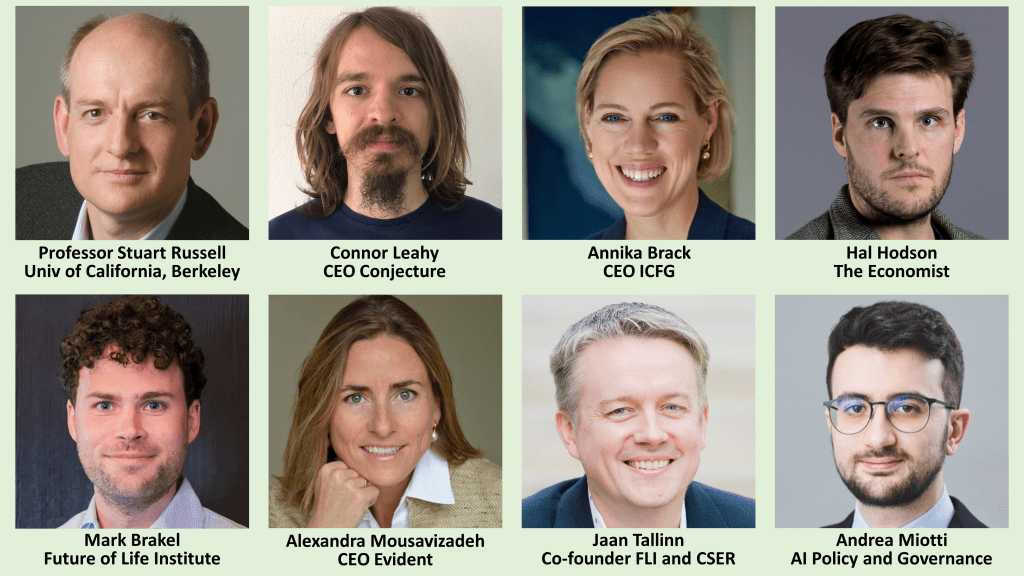
The preview event will feature a talk by Professor Stuart Russell of Berkeley, author of Human Compatible: Artificial Intelligence and the Problem of Control. This will be followed by a reply from Connor Leahy, CEO of Conjecture, and then a panel discussion that brings together leading voices from the societal debate and the political realm:
- Annika Brack, Chief Executive Officer of ICFG
- Journalist Hal Hodson from the Economist
- Mark Brakel, Policy Director at the Future of Life Institute,
- Economist Alexandra Mousavizadeh, CEO at Evident
- Technology visionary Jaan Tallinn from CSER
- Andrea Miotti, AI Policy and Governance specialist at Conjecture.
To secure your place at the preview event, click here.
To let other London Futurists know that you’re going to attend, kindly RSVP Yes on this page too.
For those who can’t make it to Wilton Hall, we are hoping to provide a livestream, but that’s not guaranteed yet, sorry!
2.) Two previews for the preview
The episode of London Futurists Podcast released this morning provides very useful background material on the planning for the Bletchley Park event. The guest is Ollie Buckley, who has been working closely with people who will be part of the Summit.
Ollie studied PPE at Oxford, and was later a policy fellow at Cambridge. After six years as a strategy consultant with Monitor, he spent a decade as a civil servant, developing digital technology policy in the Cabinet Office and elsewhere. Crucially, from 2018 to 2021 he was the founding Executive Director of the UK government’s original AI governance advisory body, the Centre for Data Ethics & Innovation (CDEI), where he led some of the original policy development regarding the regulation of AI and data-driven technologies. Since then, he has been advising tech companies, civil society and international organisations on AI policy as a consultant.
Click on the above image to listen to that episode. Or look for London Futurists in any of your favourite podcast apps.
Another preview preview (so to speak) is to watch the recording of the livestream from the event at Conway Hall on 10th October. Like the event at Wilton Hall, this was co-organised by the ERO and Conjecture, with support from London Futurists. The speakers and panellists gave us all plenty to think about!
3.) Three options for 1st November
If you’re interested or concerned about the future of AI, one option on the 1st of November is to watch the livestream of the keynote speeches from the Bletchley Park Summit.
That’s an option mentioned on the UK government’s webpage about the Summit:
Event details will be shared on the Department for Science, Innovation and Technology (DSIT)’s social media channels ahead of time with the facility to watch back and post questions and comments on social media channels at other times.
[This includes on 1 November] Watch keynote speeches on the AI Safety Summit livestream.
I’ve not yet seen the link for that livestream, but I’ll be sharing it via my social media posts once it becomes available.
A second option for 1st November is the Inclusive MKAI Global AI Ethics and Safety People’s Summit, taking place from 10am to 4pm that day.
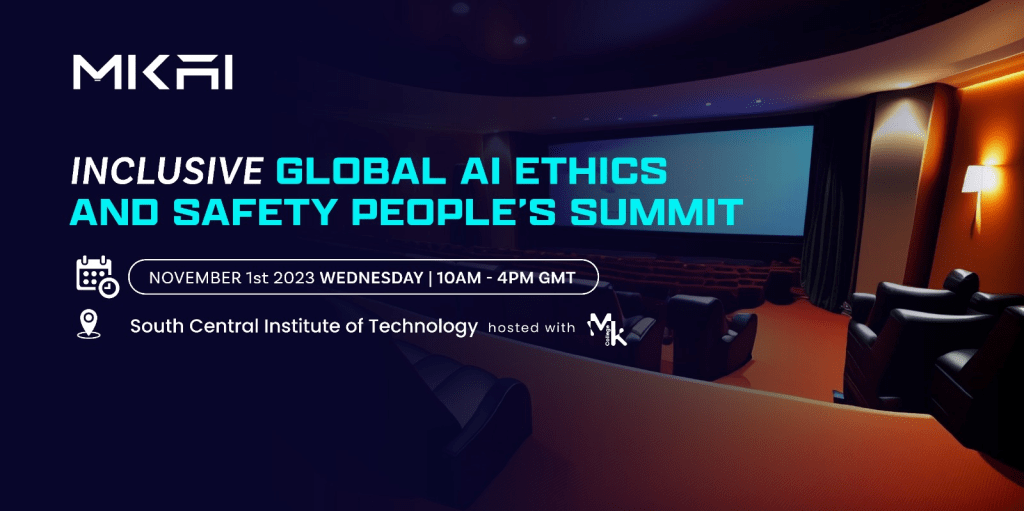
It’s organised by friends of London Futurists at MKAI.
Here’s an excerpt from their event webpage – where there are also links to register:
Rationale
The MKAI Global AI Ethics and Safety People’s Summit is an imperative, time-sensitive dialogue. Scheduled to run concurrently with the Global AI Safety Summit at Bletchley Park, this historic summit is not merely an event but a critical intervention. Hosted in partnership with Milton Keynes College at the cutting-edge South Central Institute of Technology in Bletchley, the summit addresses the immediate need for a global discourse on AI ethics and safety. In a landscape where ill-informed investments in AI are increasingly common, this summit serves as an essential platform for informed, global dialogue.
Summit Objective
The summit’s primary objective is to foster a nuanced, multi-stakeholder dialogue focused on the ethical and safety dimensions of AI. This is not a postponable discussion; it is an urgent call to action. The risks to brand reputation, human rights, and ethical governance are too significant to defer. The summit is a catalyst for immediate, actionable solutions.
You can attend in person at South Central Institute of Technology in Bletchley (part of Milton Keynes College). Or you can participate remotely.
A third option for 1st November is taking place at the Shard in London.
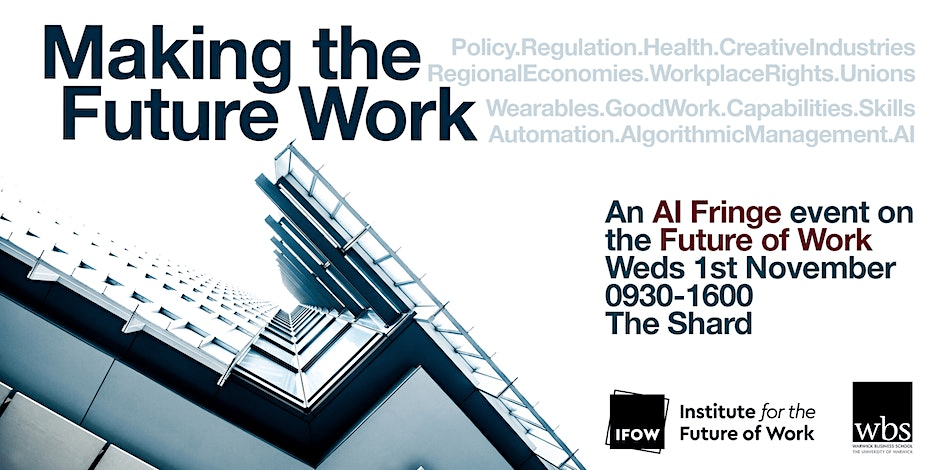
This is described as “An AI Fringe event on the Future of Work”:
While discussions at Bletchley focus on the future ephemeral ‘x-risk’ of ‘god-like’ AI, at this ‘Making the Future Work’ summit we will be grounding debate in the here-and-now of how work is being transformed and working lives impacted.
We will be convening a rich and diverse set of voices and interdisciplinary research to sessions on regulation, creative industries, health and wellbeing and what policies a future of good work requires.
To indicate your interest in attending that event, visit the corresponding Eventbrite page.
4.) Emerging Technologies and the Future of Work (IEET)
Just as existential risk of AI is, thank goodness, at last receiving more public attention, it’s the same with the impact of AI on work. I’ve just mentioned an event in London on that subject, on 1st November. But the one to which I’m really looking forward is in Boston, Massachusetts, on 3rd and 4th November:
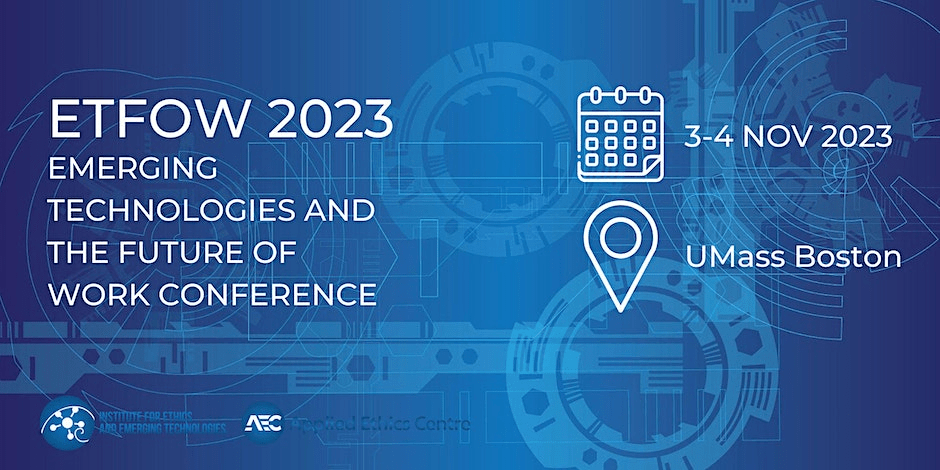
This conference is organised by the IEET (Institute for Ethics and Emerging Technologies), on whose board (to be transparent) I am a member.
Boston is a bit beyond the easy travelling circuit of most London Futurists, but in case you’re in that region in the first few days of November, please consider registering and attending. (But note that registration is scheduled to close on 20th October, so don’t delay.)
Here’s an excerpt from the event webpage:
About ETFOW 2023
Join us for the “Emerging Technologies and the Future of Work” conference, where experts in the field will come together to discuss the cutting-edge technologies that are shaping the future of work. From artificial intelligence to virtual reality, attendees will learn about the latest advancements and their potential impact on industries and the workforce. Discussions will also include the ethical considerations and challenges that come with these new technologies. Don’t miss this opportunity to gain valuable insights and network with industry leaders in this rapidly evolving field.
What to Expect
ETFOW 2023 will be a pioneering event that brings together professionals from diverse fields to discuss the intersection of emerging technologies and the future of work. Attendees will have the opportunity to network, exchange ideas, and participate in thought-provoking discussions on the impact of these technologies on industries, the workforce, and society. The conference also aims to foster interdisciplinary collaboration and provide a platform for unconventional perspectives on this rapidly evolving field.
And here are some of the talks lined up:
- The Automated Economy – Lucas Stanczyk (Harvard University)
- Work and its Unfreedom: The fix is social, not technological – Pascal Brixel (Northwestern University)
- The political theory of work and leisure – Julie Rose (Dartmouth College)
- Time to be happy: When and why autonomous products increase consumer wellbeing – Ashley Whillans (Harvard University)
- Does the future of work mean less work? The movement for a four day week – Juliet Schor (Boston College)
- How will AI affect the future of work? – Darrell West (Brookings Institution)
- Will ChatGPT eliminate more jobs than it creates? (And how would we know?) – Aaron Benanav (Syracuse University)
- Belongingness and the future of work – Igor Shoikhedbrod (St. Francis Xavier University)
- From direct selling to platform capitalism – Erik Baker (Harvard University)
- LLMs, justification and the future of work – Jake Burley (Brandeis University)
- Insights from a global freelance labor platform – Hiranya Bandara (UMass Boston)
- Caring machines: The “care crisis” and the future of digital worker surveillance – Alexandra Mateescu (Data & Society)
- Reflections on EM Forster’s “The Machine Stops” in light of current tendencies – Maria Brincker (UMass Boston)
- The nature, nurture, and future of care work – Nancy Folbre (UMass Amherst)
5.) LSE Future Impact Summit
I’ll close this newsletter by looking further ahead – to the Future Impact Summit that will be taking place the LSE in Central London on the final weekend in November.

Here are the titles for the various sessions in the latest draft of the schedule:
- Fire from the Gods – How AI could make or break us
- SocietyGPT – Data-Driven Democracy or Algorithm Autocracy?
- How to train your AI – How to use AI to win in your industry
- The Attention Monster – Guarding against the future harms of AI and emerging tech
- Next Big Thing – What will the industries and careers of the future be?
- Cyber Empires – New frontiers of techno-nationalism, conflict and geopolitics
- Heatwaves & Cold Wars – Mapping Geopolitical Flashpoints in a Warming Planet
- Building Health Resilience in the Permacrisis Era
- Cities of Tomorrow – Generation Rent, Urban Climate Impacts and PropTech solutions
- Fixing our Food – People, Processes, Policies
As you can see, the team planning this Future Impact Summit have identified lots of important questions. I’m looking forward to being part of a number of these sessions.
For more information, and to join the Waitlist for when tickets become available, click here.
// David W. Wood
Chair, London Futurists


 London Futurists