Dear Futurists,
You’re going to want to read this newsletter quickly, as it contains news of a one-day-only code for a 50% reduction on the registration tickets for this year’s CogX.
And there’s lots more that might also interest you…
1.) Six of the best CogX speakers?
With so many speakers at a single conference, it’s inevitable that there will be at least some duds – meaning, people who will trot out bland statements like “AI should be responsible, trustworthy, ethical, unbiased, and fair”, but who won’t be able to explain how these fine aspirations can be achieved in practice, nor what happens when different interpretations of these values clash.
However, as I look down the list of speakers who are announced as travelling to London to speak at this years CogX Festival – taking place 12-14th September in and around London’s O2 Arena – I see many that I am confident will deliver excellent presentations with plenty of distinctive content.
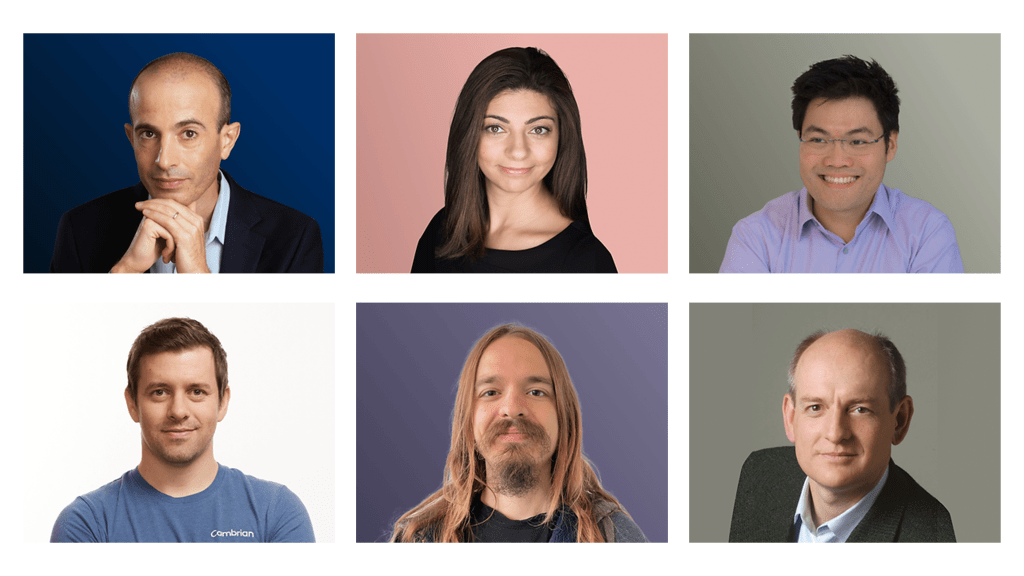
I’ve picked out six for the image above. From left to right and top to bottom:
Prof. Yuval Noah Harari is a historian, philosopher, and the bestselling author of Sapiens: A Brief History of Humankind, Homo Deus: A Brief History of Tomorrow, 21 Lessons for the 21st Century, and the series Sapiens: A Graphic History and Unstoppable Us. His books have sold 45 million copies in 65 languages, and he is considered one of the world’s most influential public intellectuals today.
Born in Israel in 1976, Harari received his PhD from the University of Oxford in 2002, and is currently a lecturer at the Department of History in the Hebrew University of Jerusalem. In 2019, following the international success of his books, Yuval Noah Harari co-founded Sapienship with his husband and original agent, Itzik Yahav. Sapienship is a social impact company with projects in the fields of entertainment and education, whose main goal is to focus the public conversation on the most important global challenges facing the world today. …
James Peyer, PhD, is the CEO & Founder of Cambrian Bio, a Distributed Drug Development Company focused on developing therapeutics targeting the biological drivers of aging. Cambrian builds, directs, operates, and finances a pipeline of therapeutics. He founded the company to translate laboratory breakthroughs in the extension of healthy lifespan into the clinic with the mission of shifting the modern medicine approach from reactive to preventative.
Before Cambrian, Dr Peyer started Apollo Ventures, the first company builder in Longevity Therapeutics, where he was the founder, investor, and CEO of multiple companies. He did his PhD with a focus on blood stem cell biology as a National Science Foundation Fellow at UT Southwestern.
Rana el Kaliouby is an Egyptian-American scientist, entrepreneur, investor and an AI thought leader on a mission to humanize technology before it dehumanizes us. She is the Deputy CEO at Smart Eye and formerly, Co-Founder and CEO of Affectiva, an MIT spin-out. … Her bestselling memoir, Girl Decoded: A Scientist’s Quest to Reclaim Our Humanity by Bringing Emotional Intelligence to Technology follows her journey, growing up in the Middle East and moving to the United States to become an entrepreneur and Emotion AI pioneer. …
A TED speaker and co-host of a PBS NOVA series on AI, Rana has been recognized on Entrepreneur’s 100 Women of Influence, Fortune’s 40 Under 40 list, Forbes’ Top 50 Women in Tech and Newsweek’s top Disruptors. She holds a Ph.D. from the University of Cambridge and a Post Doctorate from MIT.
Connor Leahy is the CEO of AI start-up, Conjecture, working on understanding large ML models and aligning them to human values.
Connor is also the co-founder of EleutherAI, a decentralized grassroots collective of volunteer researchers, engineers, and developers focused on AI alignment, scaling, and open source AI research.
Hon Weng Chong is the founder and CEO of Cortical Labs, a Deep Technology startup looking to fuse biological material with computing chips resulting in a proto-AGI device. Previously he was the founder and CTO of CliniCloud; a medtech startup that built full-stack connected medical devices that was backed by Tencent and Ping An ventures.
Hon Weng trained as a medical doctor at The University of Melbourne and was exposed to the world of technology entrepreneurialism during his research year at Johns Hopkins. In addition to being a medical doctor, Hon Weng is a full-stack software engineer and a machine learning enthusiast. Hon Weng is a Forbes 30 under 30 recipient in 2018.
Stuart Russell is a pioneer in the understanding and uses of artificial intelligence (AI), its long-term future, and its relation to humanity. He also is a leading authority on robotics and bioinformatics.
Stuart is the author or coauthor of three books on knowledge, reasoning, and machine learning, including the standard textbook on artificial intelligence. Stuart Russell is a professor of Electrical Engineering and Computer Sciences at UC-Berkeley and Adjunct Professor of Neurological Surgery at UC-San Francisco.
2.) 50% discount on CogX tickets (19th July only)
In this publicly visible version of the newsletter, I cannot share the discount code that will unlock a 50% saving on registration prices at this year’s CogX.
However, if you read the version that will be emailed to members of the London Futurists meetup later today, you’ll find all the details there.
3.) Paradigm shifts in science, health, longevity, and society
Next, here’s news of an in-real-life gathering on Thursday 27th July in a private room in the Cocktail Club near Oxford Circus in central London.
This is a joint meetup between London Futurists and DeSci London (DeSci = Decentralized Science), taking place with the kind support of VitaDAO. I’ll be the main speaker.

Healthcare has experienced a number of key disruptions over the centuries, with pre-existing “expert” opinion resisting a troublesome new idea before a sufficient wave of momentum built up to a tipping point. Progress in science and medicine isn’t always entirely rational, since obstacles arise from adverse human psychology, from dysfunctional incentive systems, and from worldviews which provided blinkers rather than discernment.
In 2023, numerous potential paradigm shifts are competing for our attention and our support. They include:
- decentralisation – as opposed to centralisation
- geroscience – focusing on the underlying mechanisms of aging rather than on specific age-related diseases
- superlongevity – not just life extension but life expansion.
These paradigm shifts are enabled by the increasing power of the NBIC technologies of the fourth industrial revolution. But just because a paradigm shift is possible, it doesn’t mean it’s desirable.
In this joint meetup, we’ll be discussing how to distinguish the healthcare paradigm shifts that are not only credible (as opposed to science fiction) but also beneficial (as opposed to deceptive). What are the prospects for a new decentralised science approach to developing and distributing superlongevity solutions?
There’s no charge to attend, but you should register in advance, thanks!
4.) Catching up with the London Futurists Podcast
Releasing a new episode every single week requires significant discipline, but it’s worth it, based on all the positive feedback I keep receiving about episodes of the London Futurists Podcast.
In case you missed any of these episodes, here’s a brief listing of the six most recent ones:

Episode 43: The 4C’s of superintelligence – co-hosts Calum Chace and I consider scenarios for the future of superintelligence
Episode 44: Catastrophe and Consent – Calum and I fill in some gaps from Episode 43
Episode 45: Generative AI drug discovery breakthrough, with Alex Zhavoronkov
Episode 46: Innovating in education: the Codam experience, with David Giron
Episode 47: AI transforming professional services, with Shamus Rae
Episode 48: The Death of Death, with José Cordeiro
We’ve also got four more episodes recorded, in various states of editing in readiness for publication in the weeks ahead. Our stated subject matter, “Anticipating and managing exponential change”, continues to grow in significance.
// David W. Wood
Chair, London Futurists


 London Futurists